Showing posts with label LSU. Show all posts

Tuesday, October 8, 2013

Living LIGO's Belated 3rd Anniversary

This past Saturday, 5 October, was the 3rd anniversary of the Living LIGO blog (you can see the first ever post here).  I remember that because it also happens to be my birthday - I started this out of a desire to do something I always wanted to so what a better day to start than your own birthday.  (If you must know, I've just celebrated the 6th anniversary of turning 29.)

I know it has been a long time since I've posted.  I've been teaching at LSU and doing research at LIGO.  On paper my life looks great but the reality is that there are many details, both personal and professional, that have added up to me not being in a great place for a while.  I've been getting my jobs done but after that I've been pretty exhausted, at least mentally.  This has happened to me before, so I thought I would direct you to my thoughts on what it's like being down but getting up again anyway here.  (Also see my last section below: "A WORD OF ADVICE...".)

But there is one thought that has come up many times in the last few months:  "I'd like to write a blog post on that."  There are many different things, like continuing the series of posts I've started about methods of looking for gravitational waves or telling the story of where silver and gold come from (as in, how did it come to be on Earth).  So, I am going to dig myself out of my slump and get back on my metaphorical horse - starting now!


WHAT I DID THIS SUMMER

Let me tell you a little about what I've been doing since I've last posted.  I got to go to a large meeting called the GR20/Amaldi10 Meeting in Warsaw, Poland (where almost 850 gravity theorists and experimentalists gathered for this joint meeting) and gave 2 invited talks.  The first was a formal talk on outreach skills and media (featuring this blog) and the other was less formal and was on the benefits searching for gravitational waves can bring mankind focusing on spin-off technology (I've written about this before here).

This is a picture of the gates of the Uniwersytet Warszawski where GR20/Amaldi10 took place.

A view through the gates at my colleagues on a coffee break in the distance.

One of the best parts of meetings like this is that the meeting dinner is usually somewhere a normal person couldn't go.  Our dinner was at the in the Royal Castle in Warsaw.  And this is my husband and I on the lawn beforehand:

My husband, Derek, and I on the lawn behind the Royal Castle in Warsaw, Poland.

Just before my trip to Warsaw, I took a short holiday to Paris, France.  There was a debacle with lost luggage and then wrong luggage being delivered to us, but outside of wearing the same clothes for a few days (this is why I always pack extra underwear in my carry-on luggage), my husband and I had a great time just relaxing and wondering around.  My new phone takes panoramic pictures and this is a good one I got of the Louvre:

Panoramic view of the Louvre (Paris, France)
Click on the picture for a larger view.

Once I returned home to the United States, I had tons of work to do.  I've talked before about how LIGO has been testing its data infrastructure to prepare for Advanced LIGO here.  We are then had our 4th software engineering run; that means that I had to improve upon the gravitational wave simulation software I wrote to perform better, faster, and incorporate more features.  It was a bit stressful come the deadline, but it all got done and turned out well.


... AND THEN SCHOOL STARTED AGAIN

Then school started again.  I am teaching (at LSU) the first semester of physical science (sometimes referred to as "Physics for Poets" since it is more conceptually based than mathematically focused).  Most of my students in this class (this year my lecture has only about 100 students) are elementary education majors.  Some might think that teaching an "easy" class like this would be, well... easy.  But it is far from it.  The less math you can rely on to teach the subject matter, the better you have to be as a teacher in communicating what the math means.  Since I love challenges like this, this is one of my favorite classes to teach.  I am also team teaching a junior/senior level class on Science Methods for secondary education pre-service teachers majoring in science or math.  This class shows them how science is done by doing experiments using the scientific method, analyzing their data and reporting it in both papers and presentation (since these are the two main means that scientists communicate with each other).

At LIGO, I am working on a paper with a group of other LIGO scientists who are looking for gravitational waves from supernovae that may have occurred while LIGO and/or other gravitational wave observatories were in operation (before the advanced detector upgrade began).  And, as always, I continue to refine my gravitational wave simulation software.


A QUICK WORD OF ADVICE...

I'll be writing again soon (probably next week).  When I first started this blog, I promised you a peek into the life of a working scientist.  Lately I've been answering lots of questions about gravity and how to look for gravitational waves.  But since there has been something major going on in my life, and it kept me from writing my blog as I would have liked, I wanted to share that with you.

I am lucky since even though I know I have times when depression can get the better of me, I have wonderful support from my husband, friends, and family.  I'm not sure why, but they all seem to love me even when I can't stand to be around myself. 

For anyone reading this who has issues with depression and/or anxiety:  Don't fool yourself that everything you are feeling inside is not affecting you because you may be able to keep it together and have others think you are happy.  This will eat at you and everything you are feeling will come out sometime (and usually at the least opportune time).  If you are sad or anxious for long periods of time, even if it's on-and-off, find some help.  It is not weak to seek help (I've been told that before and it's usually by people who need help for themselves and are too afraid to get it).  It takes an inner strength to admit when you are hurting and need a hand up, an ear to listen to you, or a shoulder to cry on.  If that's not enough, talk to your doctor.  Not once has a doctor been anything but 100% supportive of me when I've gone to them seeking medical help.  NOT ONCE did they look down on me, or suggest that my feelings will pass, or that I need to "buck up".  With support and help, I've always clawed my way back to feeling like a normal person.  You can too!

Thursday, September 13, 2012

Q: If Light is Stretched/Compressed by a GW, Why Use Light Inside LIGO?

Wow!  It's been a while since I've posted...  After the start of a new semester (I have 150 students in the class I am teaching at LSU) and Hurricane Isaac (which shut LIGO Livingston down for almost a week, LSU for 3 days, and left me without power for a while), I am just getting my life back to a somewhat normal routine.  I love even the hectic parts of my life, but I've missed writing about gravitational waves here on Living LIGO!


Q: IF LIGHT IS STRETCHED/COMPRESSED BY A GRAVITATIONAL WAVE, WHY USE LIGHT INSIDE LIGO?

Today I am addressing a question that many professional physicists fully don't understand!  I wrote a little while ago about how light and gravitational waves will stretch out as the Universe expands (this is called redshift).  If an object is coming towards us, its light is compressed (and this is called blueshift).  Basically, if objects are moving, light and gravitational waves will experience a Doppler effect.  I have also written about how a passing gravitational wave will stretch and compress space in perpendicular directions.  When you put these two facts together, you come to the conclusion that the light inside the arms of LIGO is also be stretched and compressed by a gravitational wave.  So, how can we use this light to measure gravitational waves when the light itself is affected by the gravitational wave?

Like I suggested earlier, this is not obvious upon first inspection.  The apparent paradox arises from thinking of laser light as a ruler.  When you think of light, you usually think of it as a wave (which it is, but light is also a particle - however that isn't relevant to this discussion).  Waves have a wavelength -- the distance between each successive wave:

Illustration of wavelength (represented by λ) measured from various parts of a wave. [Source: Wikipedia]

A passing gravitational wave will expand and compress space-time and the wavelength of the light we are using to measure gravitational waves is itself affected by the gravitational wave.  Since LIGO and detectors like it effectively measure the length of its arms and compares them to each other,  how can we rely on light to measure any length changes from a passing gravitational wave?

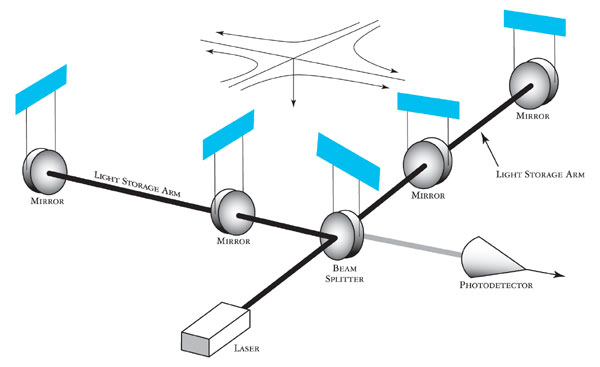
The solution begins to become clear when you start thinking of the laser light as a clock instead of a ruler.  When the light comes out of the laser, there is a fixed time between each crest of the wave (this is called the period of the wave).  Let's label each crest as 'tick' (like a clock).  Our laser (labeled 'Laser' in the image below) is very stable in that it produces a very consistent wavelength of 1064 nm (near-infrared light).  Because the speed of light is constant no matter how you measure it, that means that there are almost 282 trillion (2.817 x 10¹⁴) 'ticks' every second.  This light is then split into two equal parts (at the 'Beam Splitter' in the image below), one for each arm.

Basic diagram of the LIGO detectors.

Since different things can happen to the light once it is in the arms, let's reference the beam splitter for making length measurements (i.e., let the beam splitter stay in the same place while the gravitational wave alternates squishing and stretching the arms).  A real gravitational wave will cause one arm to shorten and the other to lengthen.  This will also cause the laser wavelength in the shortened arm to decrease (blueshift) and the wavelength in the lengthened arm to increase (redshift).  But there is nothing in the detector that measures wavelength.  What it really measures is the shift in the arrival time of each 'tick' of the wavelength crests.  If the arms stay the same length (no gravitational wave), then the 'ticks' of the laser light come back to the beam splitter at the same time and produces destructive interference where we measure the light (labeled 'Photodetector' in the image above).  If a gravitational wave causes the length of the arms to change and shifts where the 'ticks' of the laser light occur, the two light beams will no longer return to the beam splitter at the same time.  It is this "out of sync" arrival time of the crests of the laser light that produces the interference patter we utilize to detect gravitational waves - we couldn't care less about the actual wavelength of the light (other than it was consistent going into the detector).


READ MORE FROM OTHER LIGO SCIENTISTS:

A wonderful, concise summary on why light can be used in gravitational wave detectors like LIGO has been published in American Scientist here.  The author, Peter Shawhan, is an associate professor at the University of Maryland, College Park.

There is also an article in the American Journal of Physics (vol. 65, issue 6, pp. 501-505) titled "If light waves are stretched by gravitational waves, how can we use light as a ruler to detect gravitational waves?"  This is a more technical article by Peter Saulson who is a professor at Syracuse University.

Thursday, August 23, 2012

My New Jobs and Working in Academia

THE NEW JOBS

I've talked before about my current position as a postdoc (short for postdoctoral scholar/researcher/fellow/etc.).  This is a temporary position very much like a medical doctor's residency.  I've held this position for the past 5 years and I've loved it, so much so that I managed to land myself a more permanent position, or I should say positions since I now have 2 jobs.

My first job that will be replacing my postdoc (which is up at the end of the month) is "Data Analysis and EPO Scientist" for Caltech but working at the LIGO Livingston Observatory (EPO stands for Education and Public Outreach).  This is a half-time position that will allow me to continue my LIGO research and continue to perform outreach.  Basically, this new scientist job at LIGO will let me to keep doing what I've been doing for the last 5 years.

My second job is an instructor position in the LSU physics department.  This semester I am teaching conceptual physics (PHSC 1001: Physical Science) which is sometimes referred to as "physics for poets".  I am especially excited about teaching the class at LSU because many of the students are future teachers themselves.  I've taught the equivalent course to this while I was at Penn State (PHYS 001: The Science of Physics).  This was the one course I had complete control over while I was at Penn State: including text book selection, lecture & exam creation, etc.  I picked this class because it is hard to teach.  Through my previous teaching experience, I discovered that the less math you use in a physics class, the harder it is to teach.  Calculus-based physics is MUCH easier to teach than algebra-based; not because the students in the calculus-based physics class are smarter (which isn't true), but because a teacher can use math as a crutch and not have to truly articulate concepts.


THE GOOD AND THE BAD

I am really thrilled about my jobs.  Not only do I have a job (with benefits) in this economic climate, but it is in my field and doing what I love to do.  I am also back in the classroom which I missed (but loved the work in outreach I've been doing).  I get to continue doing to LIGO research.

In a sense, I have a very non-traditional "professorship" since I get to teach and do research.  The reason this isn't really a professorship is that I do not have the ability to earn tenure.  In academia, after a certain amount of time (usually 7 years) you are eligible for a promotion that makes you a permanent member of the faculty at the school.  In higher education, the evaluation criteria usually include the quality of your research (usually measured on the amount of grants you obtained and papers that you published), your teaching, and your service to the school and the profession.  At very big research schools, much more weight is placed on research; in smaller liberal arts colleges, teaching is often more important.  The fact that I am in a non-tenure track position is good in that I don't have to worry about obtaining my own research funds or publish stacks of papers and it is bad in that I am never going to have the security that tenure could bring me.  Of course, I have the option of leaving my current positions in the future and finding a tenure-track job (which isn't easy to do these days).

Another good aspect about my split position is that it think it is pretty hard to get laid off from two different jobs at the same time.  I guess that's a kind of job security...  I may not have tenure but it will be hard for me to be completely unemployed.

Ultimately, I am thrilled that two different universities are willing to claim me and I still get to do what I love...  It doesn't get much better than that!

Thursday, May 31, 2012

The Two-Body Problem: Relationships and Physicists

THE PROBLEM OF DUAL CAREER RELATIONSHIPS IN ACADEMIA

One of the more difficult things about being a physicist in a relationship is that your partner is usually also a professional in a technical field as well.  Working in specialized fields make finding jobs in the same location as your partner difficult.  So many of us have experienced these issues that we have a special name assigned to it - the two-body problem (re-purposing the phrase referring  to the physics of two masses interacting, say in orbit).

The problem isn't about finding work, but finding work working in our specialties.  For example, I am a skilled physics educator and every college and university teaches physics at some level so there are job opportunities for me in that respect.  Of course, these jobs are still very competitive to earn, but you get the idea that there is work out there.  But many of these jobs would likely be strictly or mostly teaching without much in the way of research opportunities.  I could be employed but I would likely not be able to continue my LIGO research which is important to me.  There are about 80 institutions from across the country and around the world that work in the LIGO Scientific Collaboration (click here for a list of these institutions).  While this sounds like many, the odds of not only landing a job at one of these institutions and having fulfilling job prospects for a spouse isn't great.

My two-body problem was made official in 2003.

MY TWO-BODY PROBLEM

This is usually most difficult for us academics as we finish our degrees (or when an appointment ends if the relationship started when not a student - mine did so this is what I reference).  For me, it was especially stressful since I finished my doctorate before my husband finished his.  My solution to the two-body problem: take a mini retirement.  He was supposed to graduate next semester so I figured that I would wait for him.  Besides, after writing my dissertation, I was quite burned out on research.  Well, next semester turned into the next next semester and I started to quickly lose my mind as I wasn't nearly as burned out as I thought.  I had a small contract teaching job at Penn State, but it was something that I had been doing for years as a graduate student and it wasn't challenging or time consuming.  Then I discovered vampire books and decided to do a normal person job for fun (almost all of my work previously has been in academia).  One of my students gave me tips on where to apply for a waitressing  job.  I was looking for something in the evening, like in a bar, but I ended up with breakfast/lunch service at a hotel restaurant.  Except for the very early start time (I had to be there for 6 AM, which I know isn't that early, but doesn't exist in my universe), I loved the work!  I met lots of new people and none of them treated me like I was odd because I was a physicist (since they didn't know).  This did come at a potentially steep cost professionally since effectively being out of the field for nearly a year (like I was) is usually career suicide.

Finally, there came a job I was willing to suffer a long distance relationship for - the one I have right now.  It was pure serendipity that they were also hiring engineers with my husband's skills at the same time.  We both got jobs and we are both happily employed at LIGO now.  This is EXTREMELY rare.

Now my concern is maintaining the ability to sleep under the same roof with my husband in the future.  My job here is a postdoctoral scholar is temporary, much like a medical doctor's residency.  I've been at this job for almost 5 years now (I did get promoted to senior postdoctoral scholar after my third year) which is a long time to be a postdoc at the same place.  That's not to say that it's unusual to have several postdoc appointments at different places for more than 5 years.

What to do now?  Well, I am trying to work out a new position but I don't want to jinx by talking about it here now.  This solution would let me stay put but definitely mix things up a bit for me.  Fingers crossed!

THE TWO-BODY PROBLEMS OF MY MENTORS

To give you an idea of how lucky I am to live with my husband through our transition from student to scientist, I've had two advisors on my way to getting my Ph.D. who both had extended long-distance relationships due to the two-body problem.  The first was Gabriela Gonzalez who left Penn State to go with her husband (also at Penn State) to LSU where he was offered a prestigious position and she would be able to work much closer to LIGO.  Before they found the Penn State (and then LSU) solution to their two-body problem, they worked for about 6 years hours apart from each other (you can read about their story here - you may need to register, but it's free).  When I turned down the opportunity to go to LSU with her (due to my own relationship), I then worked for Sam Finn at Penn State.  He and his wife also spent about a decade apart before they found their solution.

Conclusion, I am lucky beyond belief to not only have a job that I love but to have the one I love with me as well.

Read More:

A Dual Dilemma  (NatureJobs.com)
Is the Husband Going to be a Problem?  (New York Times)
Women in Academia: The Two Body Problem  (Persephone Magazine)

Monday, October 25, 2010

Busy Last Week: SESAPS Meeting and LaserFest Teachers' Day

Sorry for the lack of posts but I have been completely knackered after the events of last week:


SESAPS Meeting @ LSU

The American Physical Society (APS) has regional section meetings across the country and the end of last week saw the Southeast Section Meeting of the APS Meeting at LSU.  Since Initial LIGO was decommissioned a few days before, LIGO opened up a few of its vacuum chambers to the SESAPS attendees to show off the optics that were contained within.  This was indeed a rare opportunity as the chambers are only opened in between science runs AND only when there was crucial work to be done on specific components.  I work on site and I have only ever gotten to see inside a few of the chambers before.

Over 100 (and I believe I am being conservative) guests visited LIGO on Thursday afternoon and toured the Science Education Center, control room and LVEA (Laser Vacuum Equipment Area, otherwise known as the corner of the LIGO detector where all the neat stuff is).


Above is the inside of HAM6 (Horizontal Access Module - it has a table inside in instead of hanging the equipment from the top of the chamber) which is the output of the LIGO detector.  The taller piece of equipment on the table is the Output Mode Cleaner (OMC) which will help insure that the laser light has optimal intensity and phase to be used to detect gravitational waves (you can read a more detailed description of this kind of mode cleaner here).


This is what is inside of BSC1 (Beam Splitter Chamber - the kind of chamber where the equipment is hung from the top of the chamber).  This mirror (which looks like glass, but the front surface has a transparent light purple coating to make it reflective to infrared light which is what our laser is) is called ITMY (Intermediate Test Mass on the Y [south] arm).  (Test mass is our complicated way of saying mirror.)  This mirror sits just after the corner beam splitter of LIGO to intercept the light returning from the end mirror to bounce it back to the end mirror - this bouncing happens about 100 times before the light gets past the ITM to recombine with the light coming from the X arm and go to the output (which you just saw in the previous picture).


This is a picture of me and my husband, Derek (who is an engineer at LIGO).  The bright light you see shining from the left is the spot light that is illuminating ITMY.  This isn't the best picture, but I just had to have a picture of us in front of this mirror before they closed the chamber up - which is exactly what they did just after this picture was taken!


LaserFest Teachers' Day
 

I've been talking lately about the workshop I've been planning for middle/high school teachers of physical science and physics.  Since 2010 is the 50th anniversary of the invention of the laser, this year is also LaserFest.  To that end, the professional societies whose research have benefited from lasers all got together to sponsor LaserFest and to promote the educational outreach of lasers.  Since the SESAPS Meeting was taking place at LSU with physicists from all over the region, I decided it would be great to organize a LaserFest Teachers' Day to focus on the classroom kits the APS is distributing for free to teachers and to invite the meeting physicists to have lunch with the teachers and chat about what they do.

Organizing this event was quite the journey.  The first thing that needed to be done was to find the funding for the event (even if the kits are free from the APS, there are costs for food, recruiting and other miscellaneous supplies) which was supplied by the APS Forum on Education, the American Association of Physics Teachers (AAPT) and the Optical Society of America (OSA).  Then I needed to recruit teachers from the surrounding areas.  I was lucky here since I work with the LIGO Science Education Center and was able to advertise this event through their contact who also helped to spread the word.  Then there is making sure that the supplies arrive in time, contracting catering for the event, making sure that the teachers know when and where to be and insuring that you have all the incidental supplies that are needed (e.g. the kits contain everything a teacher would need except things they should already have like scissors and tape - but I needed to make sure that we had those for the workshop).  I know that none of these things sound like a lot, but this reminded me a lot of the last days before my wedding when all the details needed to fall into place at the same time.

The day started at 9 am with breakfast followed by a wonderful talk by Dr. Ken Schafer who introduced us to the basic concepts that make a laser work, their history and their applications.  We then proceeded to the first of the 4 activities in the 2009 PhysicsQuest kit (which included a laser pointer, and LED light, polarizers, glow-in-the-dark vinyl and colored light filters).  At noon, we broke for lunch and chatting with some of the physicists visiting for the SESAPS Meeting.  The rest of the afternoon saw us working through the remaining 3 activities and the day concluded at about 3 pm.


The picture above is some of the teachers hard at work doing the laser activity where we measured the width of our hair by measuring the diffraction pattern made by shining the laser on the hair.  That explains why the teacher on the left is giving herself a hair cut!

The APS has put together a useful page on arranging a Teachers' Day of your own - see it here.

I know that there are many people out there with poor opinions of our education system and the teachers within it, but I was truly inspired by these teachers who attended this workshop on their own time and without pay so that they can learn how to do these activities and take them back into their classrooms.  These teachers definitely went above and beyond to better themselves and their students!