Thursday, November 1, 2012

Gravity - The Love Story II: Starstruck!

So, where was I when I last posted...  Ahh... The great corny love story between two objects bound together by gravity.  I started that post asking what would happen to the Earth if the Sun were to suddenly become a black hole.  Many people think that the Earth would be sucked in because they assume that a black hole will suck everything into it like water going down a drain.  But, from careful examination of the universal law of gravitation and the story it tells, we see that isn't the case and the Earth will stay in the same orbit that is it now - no closer and no farther away.

But what about an object flying by a black hole (or any other massive object) instead of being in a nice stable orbit (like the Earth is in the previous example)?  This makes things a little more complicated, so I am going to let go of telling a love story.  That being said, there will be more equations here, but like the previous love story post the equations will only serve to help tell the story and we will not be using any numbers.


THE FATE OF A COSMIC WANDERER

Instead of looking at the universal gravitation law, we are going to look at how a passing object comes to be in orbit, or not, around another object (this governed by Kepler's laws of planetary motion).  To keep things simple, let's assume that the moving object has much, much less mass than the object it's passing (this is so that we can ignore the motion of the big object due to its gravitational attraction to the passing object).  Basically, picture something small whizzing through space (I'll call this the small object) that passes by a star or black hole (I'll call this the big object).  It is now safe to assume that any motion caused by gravity is going to be seen in the small object.


IT'S ALL ABOUT THE SPEED

The one factor that completely determines the fate of the small object is its speed.  If this speed is great enough, then the small object will be able to escape the big object, though its speed and direction will have changed.  The minimum speed at which the small object will not be captured into an orbit is called the escape velocity:


Here, we see that the escape velocity, ve, changes as the square root of 1/distance (1/r) between the objects' centers.  That means that the closer the small object is to the big object, the more speed it must have in order not to get caught by it; the farther away, the less speed it needs to escape.  2GM is a constant value and never changes; G being the universal gravitational constant and M being the mass of our big object.


ORBITS AND ELLIPSES

Any speed less than the escape speed and the small object will be captured by the big object and will likely start orbiting the big object (or collide with it, we'll get to that later).  Let's say that we are traveling at a speed less than the escape velocity.  Kepler's laws of planetary motion (which are a consequence of gravitation) provide that the shape of the orbit is an ellipse (an oval shape).  Instead of having one center like a circle does, an ellipse has 2 each called a focus.  A classic way to draw an ellipse for yourself is to put two pins into a piece of paper, put a loop of string around the pins, place a pen in the loop and pull the loop taut.  The shape that you draw doing this is an ellipse:

[Image from: Wikipedia]

Here, each pin is a focus.  This is what having 2 "centers" means - if you were to draw a shape using this same method but using only one pin, then you would draw a circle (the pin being the true center).  When talking about an orbit of a very massive object and much smaller object (like we have in this example, or like the Earth orbiting the Sun), the more massive object will be located at a focus and there isn't anything at the other focus.

The speed of the object determines the shape of orbit:


Here v is the speed of the orbiting object (which is less than the escape velocity), μ is a constant (G times the mass of the big object), r is the distance from the objects' centers when the velocity is measured, and a is the semi-major axis of the ellipse (the distance between the midpoint of the foci and the farthest point of the ellipse). 

[Image from: Wikipedia]


STARSTRUCK!

Under what conditions does the small object collide with the big object?  So far it sounds like the small object is either going to escape the gravitational pull of the big object or start orbiting it.  Can a black hole (assuming it's our big object) ever "swallow" anything?  Yes, indeed, but only under certain conditions...

To determine the conditions for an object to be swallowed by a black hole or collide with a star, we need to realize that neither of these objects is a nice point as we have been treating them (well, the singularity inside the black hole is a nice point, but more on that below).  Instead, objects occupy a volume and the points we were considering were really the center of mass of the object (approximately the actual center for a spherical object).  So, the small object will collide with the big object if the radius of the big object is more than the distance of closest approach of the small object's orbit.  This distance is called periapsis and is the distance along the red line (the semi-major axis) between the ellipse (orbit) and the focus (the big object) in the previous figure.  If a star has a radius of this or more, then the small object will slam into it.

NOTE:  This scenario for collision (and the one for merger with a black hole below) assumes that the objects only interact through gravity.  That means that there is no consideration here for other forces like the interactions of the objects' magnetic fields (if they have them) or resistance from the matter and radiation that stars tend to spew out.


HUNGRY, HUNGRY, BLACK HOLES

But what about the specific case of a black hole?  I mention that there is a point-like singularity in the black hole where all the mass is located.  How do we determine the shape of the whole black hole?  First, consider why a black hole is called "black"; because the gravity inside of it is so strong that the speed of light is less than the escape velocity (now you can think of our small object as a photon of light).  Since nothing can travel faster than the speed of light, nothing can escape a black hole.  So we define the edges of the black hole to be the radius at which the escape velocity equals the speed of light.  This radius is called the event horizon.  Therefore, an object (even a photon) will merge with a black hole when the distance of closest approach of its orbit is equal to or less than the event horizon.

Now that's what I call "starstruck" lovers!  Get it?  The small object strikes the big object which could be a star...  Okay, I know it's lame, but that's why I'm a physicist and not a comedian (though I do try!).


♥  Speaking of love, happy anniversary to my husband, Derek, who is always nice enough to proofread these posts.  We've been together for 16 years, married for 9 and looking forward to many more! 

Wednesday, October 31, 2012

Happy Halloween!

Wow!  I can't believe how long it has been since I've posted.  I've been horribly busy keeping up with teaching at LSU (and trying my best to make my lectures interesting), getting my LIGO work done (we are preparing for the 3rd software engineering run for Advanced LIGO [read about the first one here]), and some personal life complications that we all deal with from time to time.  I understand better why the blessing, "May you live in interesting times," is more of a curse.

So, to tide you over until my next full post (tomorrow), here is the feature presentation of the Science Education Center's monthly Science Saturday - Halloween Edition (2011):


Here, William Katzman (Science Education Center Lead) plays a laid back fellow with some paranormal explanations of "spooky phenomena".  I play a scientist who explains all of the phenomena in terms of science.  Before the day of the presentation, we decided what spooky phenomena we were going to use, but we never rehearsed the show - I'm surprised it turned out so well (if I say so myself)!

Thursday, September 27, 2012

Gravity - The Love Story I: Black Holes Are Not 'Universal' Drains

This semester I am teaching a conceptual physics class at LSU that uses minimal mathematics to understand how the Universe works.  Yesterday, we covered the chapter on gravity and my closing question to my students was, "What would happen to the Earth's orbit if the Sun were to become a black hole instantly?"  Assume that it simply changes in size from what it is now to how big a black hole with the same mass would be and the center of mass never changes.

I'm not going to make you wait...  Nothing would happen to the Earth's orbit!

This is one of the most dramatic examples of simply using an equation to tell a story that I have come across.  I suspect that much of the drama comes from the misconception that black holes WILL consume EVERYTHING, turning most people's mental picture of a black hole into a universal drain.

(I know the following analogy is a bit corny, but it makes the point that equations can tell stories and aren't just recipes to combine numbers into new numbers...)


EQUATIONS TELL A STORY

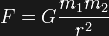
In order to resolve this misconception, consider Newton's law of universal gravitation:

  
Now, don't worry overly that this is an equation because we will be making no calculations.  Instead, we are going to use it as a script for a play.  This play just so happens to be a love story... 


THE CAST OF CHARACTERS

On the left side of "=" we don't have a character, but the ending of our story: F.  (This is the gravitational force that will be felt between two masses.)  We can also think of F as the attraction between our characters.  Therefore, the larger the attraction F, the better the 'Happily ever after...' ending.

The story is told by our characters on the right side of "=": G, m1, m2, and r:
  • G is a VERY small constant that is fundamental to the Universe.  That is, there is no way to derive its value from any theory, we simply determined this value from measurements.  Since G doesn't change, it is more of a background prop than a character; we don't need to worry about it since the moral of our story will be the same with or without it.
  • Next we have our two lovers: masses m1 and m2.  I call them lovers because they are attracted to each other (literally since gravity tends to pull mass together).  
  • Finally, we have our villain, r, who keeps our lovers apart.  (This is the distance between each of our lovers' center of mass.)  
That is the complete cast of characters in this story!  There are no extras milling around in the background.


THE PLOT

When you multiply G, m1, and m2 together and then divide by r2 (which is equivalent to r*r), you are able to determine the ending to our story which is the attraction (F) between our lovers.  Now we are able to establish some plot points:
  • The more massive either of our lovers (m1 or m2) are, the more they will be attracted to each other.
  • The farther apart (r) they are, the less they will be attracted to each other; the bigger the number you divide by, the smaller your result.  (The square on r only serves to make the reduction in attraction between our lovers less even faster.  For example, if you double the distance between the lovers, you quarter their attraction.)


THE SUBPLOT

Now let's take a look at some of the more subtle plot points, specifically the properties that determine the attraction of our lovers (m1 and m2):
  • No unrequited lovem1 and m2 are always equally attracted to each other.  It doesn't matter if one is more massive than the other.  
  • Love is blind:  There is nothing in our script which describes the size or shape of our lovers.  Assuming m1 and m2 stay the same distance apart and their masses don't change, they will always be equally attracted to each other.  m1 will love m2 the same regardless of whether its mass is made up of dense muscle or voluminous blubber. 


"ACTION!"

Now that we have the script to our play, let's see how the ending turns out when we cast the Sun as m1 and the Earth as m2.  The scene opens the with Earth orbiting the Sun a fixed distance r away (this is called an astronomical unit, AU, and it is about 93 million miles).  We sit and watch the Sun and the Earth be attracted to each other, but the villain of distance keeps them apart.  In an attempt to overcome our villain, the Sun decides to implode on itself, sucking all of its mass into a ball less than about 3.72 miles across.  Now it is a black hole but, according to our script, the Earth felt no change since its love it blind!  The mass of the Sun didn't change and its center is still in the same place.  Drat, the Sun didn't succeed in increasing its attraction with the Earth!


~ FIN ~


♥  Stay tuned for the next installment of "Gravity - The Love Story"!  We will find out what properties our lovers need to have to come together (that is, what properties a mass needs to have to actually get "eaten" by a black hole). 

Thursday, September 13, 2012

Q: If Light is Stretched/Compressed by a GW, Why Use Light Inside LIGO?

Wow!  It's been a while since I've posted...  After the start of a new semester (I have 150 students in the class I am teaching at LSU) and Hurricane Isaac (which shut LIGO Livingston down for almost a week, LSU for 3 days, and left me without power for a while), I am just getting my life back to a somewhat normal routine.  I love even the hectic parts of my life, but I've missed writing about gravitational waves here on Living LIGO!


Q: IF LIGHT IS STRETCHED/COMPRESSED BY A GRAVITATIONAL WAVE, WHY USE LIGHT INSIDE LIGO?

Today I am addressing a question that many professional physicists fully don't understand!  I wrote a little while ago about how light and gravitational waves will stretch out as the Universe expands (this is called redshift).  If an object is coming towards us, its light is compressed (and this is called blueshift).  Basically, if objects are moving, light and gravitational waves will experience a Doppler effectI have also written about how a passing gravitational wave will stretch and compress space in perpendicular directions.  When you put these two facts together, you come to the conclusion that the light inside the arms of LIGO is also be stretched and compressed by a gravitational wave.  So, how can we use this light to measure gravitational waves when the light itself is affected by the gravitational wave?

Like I suggested earlier, this is not obvious upon first inspection.  The apparent paradox arises from thinking of laser light as a ruler.  When you think of light, you usually think of it as a wave (which it is, but light is also a particle - however that isn't relevant to this discussion).  Waves have a wavelength -- the distance between each successive wave:

Illustration of wavelength (represented by λ) measured from various parts of a wave. [Source: Wikipedia]

A passing gravitational wave will expand and compress space-time and the wavelength of the light we are using to measure gravitational waves is itself affected by the gravitational wave.  Since LIGO and detectors like it effectively measure the length of its arms and compares them to each other,  how can we rely on light to measure any length changes from a passing gravitational wave?

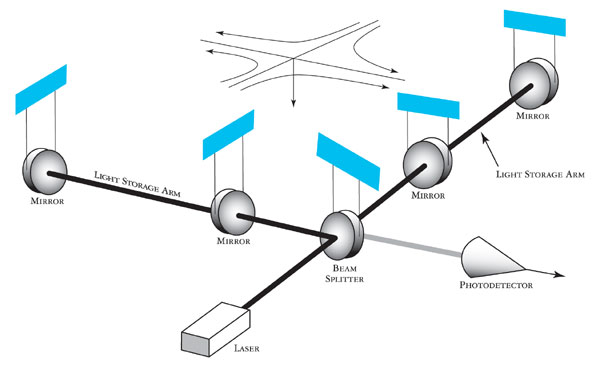
The solution begins to become clear when you start thinking of the laser light as a clock instead of a ruler.  When the light comes out of the laser, there is a fixed time between each crest of the wave (this is called the period of the wave).  Let's label each crest as 'tick' (like a clock).  Our laser (labeled 'Laser' in the image below) is very stable in that it produces a very consistent wavelength of 1064 nm (near-infrared light).  Because the speed of light is constant no matter how you measure it, that means that there are almost 282 trillion (2.817 x 10¹⁴) 'ticks' every second.  This light is then split into two equal parts (at the 'Beam Splitter' in the image below), one for each arm.

Basic diagram of the LIGO detectors.

Since different things can happen to the light once it is in the arms, let's reference the beam splitter for making length measurements (i.e., let the beam splitter stay in the same place while the gravitational wave alternates squishing and stretching the arms).  A real gravitational wave will cause one arm to shorten and the other to lengthen.  This will also cause the laser wavelength in the shortened arm to decrease (blueshift) and the wavelength in the lengthened arm to increase (redshift).  But there is nothing in the detector that measures wavelength.  What it really measures is the shift in the arrival time of each 'tick' of the wavelength crests.  If the arms stay the same length (no gravitational wave), then the 'ticks' of the laser light come back to the beam splitter at the same time and produces destructive interference where we measure the light (labeled 'Photodetector' in the image above).  If a gravitational wave causes the length of the arms to change and shifts where the 'ticks' of the laser light occur, the two light beams will no longer return to the beam splitter at the same time.  It is this "out of sync" arrival time of the crests of the laser light that produces the interference patter we utilize to detect gravitational waves - we couldn't care less about the actual wavelength of the light (other than it was consistent going into the detector).


READ MORE FROM OTHER LIGO SCIENTISTS:

A wonderful, concise summary on why light can be used in gravitational wave detectors like LIGO has been published in American Scientist here.  The author, Peter Shawhan, is an associate professor at the University of Maryland, College Park.

There is also an article in the American Journal of Physics (vol. 65, issue 6, pp. 501-505) titled "If light waves are stretched by gravitational waves, how can we use light as a ruler to detect gravitational waves?"  This is a more technical article by Peter Saulson who is a professor at Syracuse University.

Thursday, August 23, 2012

My New Jobs and Working in Academia

THE NEW JOBS

I've talked before about my current position as a postdoc (short for postdoctoral scholar/researcher/fellow/etc.).  This is a temporary position very much like a medical doctor's residency.  I've held this position for the past 5 years and I've loved it, so much so that I managed to land myself a more permanent position, or I should say positions since I now have 2 jobs.

My first job that will be replacing my postdoc (which is up at the end of the month) is "Data Analysis and EPO Scientist" for Caltech but working at the LIGO Livingston Observatory (EPO stands for Education and Public Outreach).  This is a half-time position that will allow me to continue my LIGO research and continue to perform outreach.  Basically, this new scientist job at LIGO will let me to keep doing what I've been doing for the last 5 years.

My second job is an instructor position in the LSU physics department.  This semester I am teaching conceptual physics (PHSC 1001: Physical Science) which is sometimes referred to as "physics for poets".  I am especially excited about teaching the class at LSU because many of the students are future teachers themselves.  I've taught the equivalent course to this while I was at Penn State (PHYS 001: The Science of Physics).  This was the one course I had complete control over while I was at Penn State: including text book selection, lecture & exam creation, etc.  I picked this class because it is hard to teach.  Through my previous teaching experience, I discovered that the less math you use in a physics class, the harder it is to teach.  Calculus-based physics is MUCH easier to teach than algebra-based; not because the students in the calculus-based physics class are smarter (which isn't true), but because a teacher can use math as a crutch and not have to truly articulate concepts.


THE GOOD AND THE BAD

I am really thrilled about my jobs.  Not only do I have a job (with benefits) in this economic climate, but it is in my field and doing what I love to do.  I am also back in the classroom which I missed (but loved the work in outreach I've been doing).  I get to continue doing to LIGO research.

In a sense, I have a very non-traditional "professorship" since I get to teach and do research.  The reason this isn't really a professorship is that I do not have the ability to earn tenure.  In academia, after a certain amount of time (usually 7 years) you are eligible for a promotion that makes you a permanent member of the faculty at the school.  In higher education, the evaluation criteria usually include the quality of your research (usually measured on the amount of grants you obtained and papers that you published), your teaching, and your service to the school and the profession.  At very big research schools, much more weight is placed on research; in smaller liberal arts colleges, teaching is often more important.  The fact that I am in a non-tenure track position is good in that I don't have to worry about obtaining my own research funds or publish stacks of papers and it is bad in that I am never going to have the security that tenure could bring me.  Of course, I have the option of leaving my current positions in the future and finding a tenure-track job (which isn't easy to do these days).

Another good aspect about my split position is that it think it is pretty hard to get laid off from two different jobs at the same time.  I guess that's a kind of job security...  I may not have tenure but it will be hard for me to be completely unemployed.

Ultimately, I am thrilled that two different universities are willing to claim me and I still get to do what I love...  It doesn't get much better than that!

Friday, August 10, 2012

The Journey of a Gravitational Wave III: GWs Stretch Out

What happens to a gravitational wave between when it is produced and when LIGO can detect it?  It turns out not much, which makes it a key new medium in which to observe the Universe!

Today I will be discussing how a gravitational wave can get stretched during its journey to Earth.  Previously, we have discussed how gravitational waves can be bent away from a straight path and how things cannot absorb or reflect a gravitational wave.


THE DOPPLER EFFECT

If you have ever been passed by an ambulance or police car with its sirens on, then you likely noticed that as the sound from the siren approached you, the tone was higher than when the siren passed you.  This is due to something called the Doppler effect.  As the source of a sound is moving toward toward you, the distance between the sound wave's crests (wavelength) are compressed, resulting in a higher frequency.  We hear higher frequencies as higher tones.  Conversely, when the source of a sound is moving away from you, the sounds wave's crests are stretched apart resulting in a lower frequency and a lower tone.  Consider the following animated example:

Animated example of the Doppler effect: how motion and cause the wavelength of sound to be affected.
[Image from Wikipedia]

In the beginning of this animation, the car is not moving and the sound waves have the same wavelength both in front and behind the car.  Once it starts moving forward (to the left), the sound waves in front of the car are closer together and the sound waves behind the car are farther apart.  This results in us hearing a higher tone when you are in front of the car and a lower tone when you are behind the car.


COSMOLOGICAL REDSHIFT

This Doppler effect can also affect the wavelength of light and of a gravitational wave depending on the motion of the object creating the waves.  First, let's think about what happens to light.  As the source moves toward you, the wavelength of the light will get shorter.  Since we can't hear light, instead of hearing a higher tone, we will see the light to be shifted toward the blue end of the spectrum (where the shortest wavelengths we can see are).  This is called blueshift.  For a source moving away from us, the wavelengths would be longer and we would see the light shifted toward the red end of the spectrum (where the longest wavelengths we can see are).  This is called redshift.

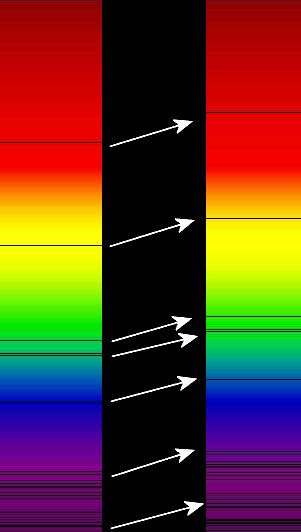
We can measure this cosmological Doppler effect by measuring the spectral signatures of stars.  Below is an example of such a spectral signature.  Stars give off almost every color of light, but there are particular colors that get absorbed by different elements before that light can make it to Earth.  Those absorbed colors show up as dark lines in an otherwise complete spectrum of colors:

The optical spectrum from our Sun (left) compared to the optical spectrum of a supercluster of galaxies (right).  Note that there are similar dark lines (from absorption of those wavelengths by different chemical elements), but the lines on the right are shifted toward the red end of the spectrum.  This phenomena is called "redshift" because of this.  [Source: Wikipedia]

The spectrum to the left is what we observe from our local star, the Sun.  The spectrum on the right is from a distant cluster of galaxies (containing many stars).  Note that the spacing of the dark lines is essentially the same, just shifted toward the red end of the spectrum (this is highlighted by the arrows).  That means that this cluster of galaxies is moving away from us.  Just about everything (but not quite) in the Universe shows this redshift which implies that the Universe is expanding!  (There is more than one cause of redshift, but we will only be discussing the redshift due to the expanding Universe in this blog post.)

Redshift is measured by the change in wavelength of light (or a gravitational wave) divided by the wavelength of light if the source wasn't moving.  For the spectrum example here, this would be the amount the color of the light changed (the difference between the right and the left side) divided by its original color (the left side).  The redshift is a result of the Doppler effect; it can also be used to measure an object's velocity.  To do that, we need to determine the proportionality constant between redshift and velocity.  This constant is known as the Hubble constant, H (named after Edwin Hubble who first determined this relationship).  The best estimate of this constant is currently:

H = 71.0 ± 2.5 km/s/Mpc
        67.2 ± 1.2 km/s/Mpc
(revised on 20 March 2013 with the parameters released by Planck)

This means that for every light-year away an object is, its velocity away from us increases by about 257 feet/hour.  (This may not sound like much, but a light-year is really a very small distance in the Universe; our own galaxy is about 110,000 light-years across!)  This expansion is believed to have originated with the Big Bang.  So, will the Universe expand forever?  Will it slow to a stop?  Will it stop expanding and start shrinking until everything is a compact ball again (this is called the Big Crunch)?  From current observations, the ultimate fate of the Universe appears to be an eternal slowing expansion which will cause all of the energy to be evenly distributed throughout this even larger Universe (compared to now).  That means that there won't be enough energy in any one place to make anything happen (all events in the Universe need an imbalance in energy).  This is called the Big Freeze or the heat death of the Universe.  However, more observations (especially of things like dark matter and dark energy) of our Universe are needed before we can be sure of the Universe's future.


BLUESHIFT

There are a few things in our Universe that are moving towards us and therefore have a blueshift.  Of most note is the Andromeda Galaxy which is moving towards us at about 300,000 meters/s (671,801 mph).  This is because our Milky Way Galaxy and the Andromeda Galaxy are gravitationally bound to each other; this means that the gravitational attractions between these two galaxies are greater than the expansion of the Universe.  In the future, our two galaxies will collide, but not for an estimated 4.5 billion years.  This is also about the time the that our Sun will become a red giant and all life on Earth will be extinct by then anyway!  I wouldn't stress about it if I were you :P

Also, portions of rotating galaxies can be blueshifted.  In this case, the side that is rotating toward us will be blueshifted and the part that is rotating away from us will be redshifted.


GRAVITATIONAL WAVES AND REDSHIFT

Just like redshift stretches out the wavelength of light, the expansion of the Universe will also stretch out the wavelength of a gravitational wave during its journey to Earth.  In a previous post, I discussed what gravitational waves would sound like if you put their signal through a speaker (remember: gravitational waves don't make sound!).  So, I decided I wanted to hear what the change in the sound of a gravitational wave is due to different amounts of redshift.  I did the calculations, generated the sounds, and assembled them into the video below for your viewing pleasure:


So, how can we make use of the redshifting of a gravitational wave to learn more about our Universe?  Well, most astronomers and physicists don't believe that the rate of expansion of the Universe (the Hubble constant, H, above) has been the same since the Big Bang.  Particularly, there is a period believed to have existed in the past history of the Universe called inflation which is a time of rapid expansion.  From a certain kind gravitational wave source, we will be able to measure the Hubble constant around the neighborhood of the source.  This will be a direct probe of how the expansion of the Universe (the Hubble constant) has changed through the history of the Universe because observing objects in the distance is the same as observing them as they were in the past (e.g. observing an object 1 light-year away is the same as observing it as it was a year ago since light and gravitational waves travel at the speed of light - at least gravitational waves are expected to travel at the speed of light!).

Thursday, July 26, 2012

The Journey of a Gravitational Wave II: GWs Get Bent

What happens to a gravitational wave between when it is produced and when LIGO can detect it?  It turns out not much, which makes it a key new medium in which to observe the Universe!

Last week, I began discussing what happens to a gravitational wave as it makes its way from its source to Earth; specifically that gravitational wave can travel through matter and come out the other side unchangedToday's post talks about how the gravitational effects of other masses in the Universe can deflect the gravitational wave from its otherwise straight path.


GRAVITATIONAL LENSING

Let's think again about what happens to light on its way to Earth.  We know from the last post that any matter light comes into contact with will reflect or absorb at least part of the light.  There is also another effect called gravitational lensing that causes light to bend around massive objects due to the massive object's gravitational influence.  This is caused by light following its natural path on curved spacetime (or light being bent by a gravitational field since we've previously established that the curvature of spacetime is a representation of the strength of the gravitational field there).  The first thing that pops into my mind that illustrates something following its natural path on a curved surface is miniature golf:

This is hole 13 at Safari Mini Golf in Vero Beach, FL.  This image is taken from a review of this course and can be read here.
Consider the example hole in the above image.  After you get your ball past the three bumps, there is a wonderful bowl-like curved portion behind the target hole (if you look very closely, you can see the hole directly after the last bump and in the center).  If you hit your ball into this area, the ball's trajectory will change from a straight path to a curved one.  If your ball begins its path on the left side of the bowl, it will curve right; if your ball enters the bowl from the right, it will curve left.  The same thing happens for light and gravitational waves that pass by a massive enough object to cause a significant depression in spacetime (i.e. a strong gravitational field):

The bending of light from a star that is really behind the Sun but appears to be to the side of the Sun.
[Credit: Ethan Siegel of Lewis & Clark College, OR]

The the light from a star, galaxy, or other source travels through the depression in spacetime made by a nearby massive object (in the image above it is the Sun).  The path that light takes is curved just like the golf ball in the miniature golf example above.  But our brains are wired to assume that any light that enters our eyes has come to us in a straight line (which is how light usually travels) so we perceive the location of the source to be directly behind where it appears to be.  Therefore, while the star is really behind the Sun (at point A in the image above), it appears to us to be to the side of the Sun (at point B).  This bending effect is called gravitational lensing and it applies to gravitational waves just like it does to light.


KINDS OF GRAVITATIONAL LENSING

The example of gravitational lensing given above was one of the first observational proofs that Einstein's general relativity was correct.  Before relativity, there was already a prediction of the bending of light due to Newtonian gravity (what we use in our everyday life) but Einstein predicted the bending effect should be twice that predicted without relativity.  In 1919, there was a total eclipse of the Sun which would allow those stars that are near the Sun to become visible.  Images of the eclipse were taken and it was seen that the shift in the position of stars near the Sun was indeed twice that of the shift predicted by Newtonian gravity.

There are also kinds of lensing that produce much more dramatic effects than shifting the position of stars!  Things like large galaxies and clusters of galaxies can cause the light from objects behind them to be split up to form multiple, separate, and complete images. 

[Image from NASA]

The image above shows gravitational lensing of a quasar and a galaxy by a distant galaxy cluster SDSS J1004+4112 (SDSS indicates that it was discovered by the Sloan Digital Sky Survey).  Each image of the quasar is of the same single object; the same is true of the galaxy! 

You may notice that each of the images are a little different from each other.  This is due to the distortion that a gravitational lens can cause.  This effect is illustrated well in the simulation below of a black hole creating a gravitational lens as it passes in front of a galaxy:

[Image from Wikipedia]

Note the circular distortion of the light from the galaxy as the black hole passes by.  When the black hole is directly in front of the galaxy, there is a circular halo of lensed light around it.  This halo called an Einstein Ring can can be caused by any extremely massive object (black hole, galaxy, galaxy cluster, etc.).
[Image credited within the image and retrieved from Wikipedia.]


HOW LENSING AFFECTS THE SEARCH FOR GRAVITATIONAL WAVES

Gravitational lensing affects both light and gravitational waves.  This produces spectacular images of objects using light, but LIGO will not produce images and the sources that produce gravitational waves are more point-like (a black hole, a star exploding, etc.) than large scale objects (like galaxies which are thousands of light-years across).  The effect that will most likely be seen in gravitational waves is their focusing; the bending of gravitational waves can produce more intense gravitational waves from the lensed source (similar to a magnifying glass focusing light to a smaller point).  This paper suggests that the galactic center of the Milky Way could increase the intensity of a source in our galaxy (bur behind the galactic center) up to 4000x.  Also, if a gravitational wave is emitted from a galaxy that has multiple images from lensing, then that gravitational wave will come from each image!

However, most sources will not have appreciable lensing.  While this is something we will always need to consider while conducting gravitational-wave astronomy, it isn't something that is likely to change the information contained on the gravitational wave noticeably (and that's a good thing)!