I've talked before about my current position as a postdoc (short for postdoctoral scholar/researcher/fellow/etc.). This is a temporary position very much like a medical doctor's residency. I've held this position for the past 5 years and I've loved it, so much so that I managed to land myself a more permanent position, or I should say positions since I now have 2 jobs.
My first job that will be replacing my postdoc (which is up at the end of the month) is "Data Analysis and EPO Scientist" for Caltech but working at the LIGO Livingston Observatory (EPO stands for Education and Public Outreach). This is a half-time position that will allow me to continue my LIGO research and continue to perform outreach. Basically, this new scientist job at LIGO will let me to keep doing what I've been doing for the last 5 years.
My second job is an instructor position in the LSU physics department. This semester I am teaching conceptual physics (PHSC 1001: Physical Science) which is sometimes referred to as "physics for poets". I am especially excited about teaching the class at LSU because many of the students are future teachers themselves. I've taught the equivalent course to this while I was at Penn State (PHYS 001: The Science of Physics). This was the one course I had complete control over while I was at Penn State: including text book selection, lecture & exam creation, etc. I picked this class because it is hard to teach. Through my previous teaching experience, I discovered that the less math you use in a physics class, the harder it is to teach. Calculus-based physics is MUCH easier to teach than algebra-based; not because the students in the calculus-based physics class are smarter (which isn't true), but because a teacher can use math as a crutch and not have to truly articulate concepts.
THE GOOD AND THE BAD
I am really thrilled about my jobs. Not only do I have a job (with benefits) in this economic climate, but it is in my field and doing what I love to do. I am also back in the classroom which I missed (but loved the work in outreach I've been doing). I get to continue doing to LIGO research.
In a sense, I have a very non-traditional "professorship" since I get to teach and do research. The reason this isn't really a professorship is that I do not have the ability to earn tenure. In academia, after a certain amount of time (usually 7 years) you are eligible for a promotion that makes you a permanent member of the faculty at the school. In higher education, the evaluation criteria usually include the quality of your research (usually measured on the amount of grants you obtained and papers that you published), your teaching, and your service to the school and the profession. At very big research schools, much more weight is placed on research; in smaller liberal arts colleges, teaching is often more important. The fact that I am in a non-tenure track position is good in that I don't have to worry about obtaining my own research funds or publish stacks of papers and it is bad in that I am never going to have the security that tenure could bring me. Of course, I have the option of leaving my current positions in the future and finding a tenure-track job (which isn't easy to do these days).
Another good aspect about my split position is that it think it is pretty hard to get laid off from two different jobs at the same time. I guess that's a kind of job security... I may not have tenure but it will be hard for me to be completely unemployed.
Ultimately, I am thrilled that two different universities are willing to claim me and I still get to do what I love... It doesn't get much better than that!
What happens to a gravitational wave between when it is produced and
when LIGO can detect it? It turns out not much, which makes it a key
new medium in which to observe the Universe!
If you have ever been passed by an ambulance or police car with its sirens on, then you likely noticed that as the sound from the siren approached you, the tone was higher than when the siren passed you. This is due to something called the Doppler effect. As the source of a sound is moving toward toward you, the distance between the sound wave's crests (wavelength) are compressed, resulting in a higher frequency. We hear higher frequencies as higher tones. Conversely, when the source of a sound is moving away from you, the sounds wave's crests are stretched apart resulting in a lower frequency and a lower tone. Consider the following animated example:
Animated example of the Doppler effect: how motion and cause the wavelength of sound to be affected.
[Image from Wikipedia]
In the beginning of this animation, the car is not moving and the sound waves have the same wavelength both in front and behind the car. Once it starts moving forward (to the left), the sound waves in front of the car are closer together and the sound waves behind the car are farther apart. This results in us hearing a higher tone when you are in front of the car and a lower tone when you are behind the car.
COSMOLOGICAL REDSHIFT
This Doppler effect can also affect the wavelength of light and of a gravitational wavedepending on the motion of the object creating the waves. First, let's think about what happens to light. As the source moves toward you, the wavelength of the light will get shorter. Since we can't hear light, instead of hearing a higher tone, we will see the light to be shifted toward the blue end of the spectrum (where the shortest wavelengths we can see are). This is called blueshift. For a source moving away from us, the wavelengths would be longer and we would see the light shifted toward the red end of the spectrum (where the longest wavelengths we can see are). This is called redshift.
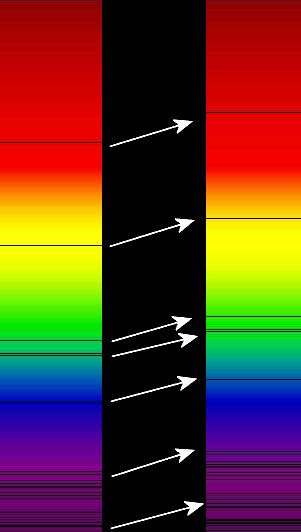
We can measure this cosmological Doppler effect by measuring the spectral signatures of stars. Below is an example of such a spectral signature. Stars give off almost every color of light, but there are particular colors that get absorbed by different elements before that light can make it to Earth. Those absorbed colors show up as dark lines in an otherwise complete spectrum of colors:
The optical spectrum from our Sun (left) compared to the optical spectrum of a supercluster of galaxies (right). Note that there are similar dark lines (from absorption of those wavelengths by different chemical elements), but the lines on the right are shifted toward the red end of the spectrum. This phenomena is called "redshift" because of this. [Source: Wikipedia]
The spectrum to the left is what we observe from our local star, the Sun. The spectrum on the right is from a distant cluster of galaxies (containing many stars). Note that the spacing of the dark lines is essentially the same, just shifted toward the red end of the spectrum (this is highlighted by the arrows). That means that this cluster of galaxies is moving away from us. Just about everything (but not quite) in the Universe shows this redshift which implies that the Universe is expanding! (There is more than one cause of redshift, but we will only be discussing the redshift due to the expanding Universe in this blog post.)
Redshift is measured by the change in wavelength of light (or a gravitational wave) divided by the wavelength of light if the source wasn't moving. For the spectrum example here, this would be the amount the color of the light changed (the difference between the right and the left side) divided by its original color (the left side). The redshift is a result of the Doppler effect; it can also be used to measure an object's velocity. To do that, we need to determine the proportionality constant between redshift and velocity. This constant is known as the Hubble constant, H (named after Edwin Hubble who first determined this relationship). The best estimate of this constant is currently:
H = 71.0 ± 2.5 km/s/Mpc 67.2 ± 1.2 km/s/Mpc
(revised on 20 March 2013 with the parameters released by Planck)
This means that for every light-year away an object is, its velocity away from us increases by about 257 feet/hour. (This may not sound like much, but a light-year is really a very small distance in the Universe; our own galaxy is about 110,000 light-years across!) This expansion is believed to have originated with the Big Bang. So, will the Universe expand forever? Will it slow to a stop? Will it stop expanding and start shrinking until everything is a compact ball again (this is called the Big Crunch)? From current observations, the ultimate fate of the Universe appears to be an eternal slowing expansion which will cause all of the energy to be evenly distributed throughout this even larger Universe (compared to now). That means that there won't be enough energy in any one place to make anything happen (all events in the Universe need an imbalance in energy). This is called the Big Freeze or the heat death of the Universe. However, more observations (especially of things like dark matter and dark energy) of our Universe are needed before we can be sure of the Universe's future.
BLUESHIFT
There are a few things in our Universe that are moving towards us and therefore have a blueshift. Of most note is the Andromeda Galaxy which is moving towards us at about 300,000 meters/s (671,801 mph). This is because our Milky Way Galaxy and the Andromeda Galaxy are gravitationally bound to each other; this means that the gravitational attractions between these two galaxies are greater than the expansion of the Universe. In the future, our two galaxies will collide, but not for an estimated 4.5 billion years. This is also about the time the that our Sun will become a red giant and all life on Earth will be extinct by then anyway! I wouldn't stress about it if I were you :P
Also, portions of rotating galaxies can be blueshifted. In this case, the side that is rotating toward us will be blueshifted and the part that is rotating away from us will be redshifted.
GRAVITATIONAL WAVES AND REDSHIFT
Just like redshift stretches out the wavelength of light, the expansion of the Universe will also stretch out the wavelength of a gravitational wave during its journey to Earth. In a previous post, I discussed what gravitational waves would sound like if you put their signal through a speaker (remember: gravitational waves don't make sound!). So, I decided I wanted to hear what the change in the sound of a gravitational wave is due to different amounts of redshift. I did the calculations, generated the sounds, and assembled them into the video below for your viewing pleasure:
So, how can we make use of the redshifting of a gravitational wave to learn more about our Universe? Well, most astronomers and physicists don't believe that the rate of expansion of the Universe (the Hubble constant, H, above) has been the same since the Big Bang. Particularly, there is a period believed to have existed in the past history of the Universe called inflation which is a time of rapid expansion. From a certain kind gravitational wave source, we will be able to measure the Hubble constant around the neighborhood of the source. This will be a direct probe of how the expansion of the Universe (the Hubble constant) has changed through the history of the Universe because observing objects in the distance is the same as observing them as they were in the past (e.g. observing an object 1 light-year away is the same as observing it as it was a year ago since light and gravitational waves travel at the speed of light - at least gravitational waves are expected to travel at the speed of light!).
What happens to a gravitational wave between when it is produced and
when LIGO can detect it? It turns out not much, which makes it a key
new medium in which to observe the Universe!
Let's think again about what happens to light on its way to Earth. We know from the last post
that any matter light comes into contact with will reflect or absorb at
least part of the light. There is also another effect called gravitational lensing
that causes light to bend around massive objects due to the massive
object's gravitational influence. This is caused by light following its
natural path on curved spacetime (or light being bent by a
gravitational field since we've previously established
that the curvature of spacetime is a representation of the strength of
the gravitational field there). The first thing that pops into my mind
that illustrates something following its natural path on a curved
surface is miniature golf:
This is hole 13 at Safari Mini Golf in Vero Beach, FL. This image is taken from a review of this course and can be read here.
Consider
the example hole in the above image. After you get your ball past the
three bumps, there is a wonderful bowl-like curved portion behind the
target hole (if you look very closely, you can see the hole directly after the last bump and in the center). If you hit your ball into this area, the ball's trajectory
will change from a straight path to a curved one. If your ball begins
its path on the left side of the bowl, it will curve right; if your ball
enters the bowl from the right, it will curve left. The same thing
happens for light and gravitational waves that pass by a massive enough
object to cause a significant depression in spacetime (i.e. a strong gravitational
field):
The bending of light from a star that is really behind the Sun but appears to be to the side of the Sun.
[Credit: Ethan Siegel of Lewis & Clark College, OR]
The
the light from a star, galaxy, or other source travels through the
depression in spacetime made by a nearby massive object (in the image
above it is the Sun). The path that light takes is curved just like
the golf ball in the miniature golf example above. But our brains are
wired to assume that any light that enters our eyes has come to us in a
straight line (which is how light usually travels) so we perceive the
location of the source to be directly behind where it appears to be.
Therefore, while the star is really behind the Sun (at point A in the
image above), it appears to us to be to the side of the Sun (at point
B). This bending effect is called gravitational lensing and it applies to gravitational waves just like it does to light.
KINDS OF GRAVITATIONAL LENSING
The
example of gravitational lensing given above was one of the first observational proofs that Einstein's general relativity was correct.
Before relativity, there was already a prediction of the bending of light due to
Newtonian gravity (what we use in our everyday life) but Einstein
predicted the bending effect should be twice that predicted without
relativity. In 1919, there was a total eclipse of the Sun which would
allow those stars that are near the Sun to become visible. Images of
the eclipse were taken and it was seen that the shift in the position of
stars near the Sun was indeed twice that of the shift predicted by
Newtonian gravity.
There are also kinds of lensing that produce much more dramatic
effects than shifting the position of stars! Things like large galaxies and clusters
of galaxies can cause the light from objects behind them to be split up
to form multiple, separate, and complete images.
The image above shows gravitational lensing of a
quasar and a galaxy by a distant galaxy cluster SDSS J1004+4112 (SDSS
indicates that it was discovered by the Sloan Digital Sky Survey). Each image of the quasar is of the same single object; the same is true of the galaxy!
You may notice that each of the images are a little different
from each other. This is due to the distortion that a gravitational
lens can cause. This effect is illustrated well in the simulation below
of a black hole creating a gravitational lens as it passes in front of a
galaxy:
Note the circular distortion of the
light from the galaxy as the black hole passes by. When the black hole
is directly in front of the galaxy, there is a circular halo of lensed
light around it. This halo called an Einstein Ring can can be caused by any extremely massive object (black hole, galaxy, galaxy cluster, etc.).
[Image credited within the image and retrieved from Wikipedia.]
HOW LENSING AFFECTS THE SEARCH FOR GRAVITATIONAL WAVES
Gravitational
lensing affects both light and gravitational waves. This produces
spectacular images of objects using light, but LIGO will not produce images and the
sources that produce gravitational waves are more point-like (a black
hole, a star exploding, etc.) than large scale objects (like galaxies which are thousands of light-years across).
The effect that will most likely be seen in gravitational waves is
their focusing; the bending of gravitational waves can produce more
intense gravitational waves from the lensed source (similar to a magnifying glass focusing light to a smaller point). This paper
suggests that the galactic center of the Milky Way could increase the
intensity of a source in our galaxy (bur behind the galactic center) up
to 4000x. Also, if a gravitational wave is emitted from a galaxy that
has multiple images from lensing, then that gravitational wave will come
from each image!
However, most sources will not have appreciable
lensing. While this is something we will always need to consider while
conducting gravitational-wave astronomy, it isn't something that is
likely to change the information contained on the
gravitational wave noticeably (and that's a good thing)!
What happens to a gravitational wave between when it is produced and when LIGO can detect it? It turns out not much, which makes it a key new medium in which to observe the Universe!
In order to make this information more digestible, I will address one aspect of a gravitational wave's journey through space. Today's topic discusses how the Universe is essentially transparent to a gravitational wave. Future editions will discuss how matter can bend gravitational waves (gravitational lensing) and how the expanding Universe can stretch out (redshift) gravitational waves.
GRAVITATIONAL WAVES CAST NO SHADOWS:
First, let's think about what happens to light. As light travels through the Universe, any time that it encounters other matter, some of the light is absorbed by the matter or reflected away from its original path. The opposite happens for a gravitational wave; it can pass through matter and come out the other side unchanged (although there are some negligible effects)! That means that there is no such thing as a gravitational-wave shadow and nothing can obscure our detection of a gravitational wave!
The Spacetime Explanation:
But why is this? In a previous post, I described a gravitational wave as a change in the gravitational field moving out into the Universe. This change in gravitational field is often illustrated as a ripple, or wave, on spacetime (where the steepness of the curvature of spacetime represents the strength of the gravitational field, or the gravitational force a mass would feel, there). Let's look at what the Earth sitting on space-time looks like:
This picture isn't a perfect representation since the size of the Earth will affect the shape of the depression and this has no effect on real spacetime. Also, this is a simplified 2-dimenional representation of 3-dimensional (or a snapshot of the 4-dimensional spacetime) space. But if you were to imagine giving a corner of this flexible grid (spacetime) a swift shake, the Earth in the middle would be affected by it but it would not impede the wave. So, this is an example of how matter doesn't interact with gravitational waves, but I am still somewhat unsatisfied with this since you may think that the Earth will bounce after a wave passes creating more waves of its own (here is another aspect where this representation of spacetime is not perfect).
FYI: A better 3-dimensional representation of spacetime is shown in this clip from the American Museum of Natural History's short documentary called Gravity: Making Waves (which can be seen in its entirety on my Viewing Fun! page). This animation shows a grid-like scaffolding filling space in which there is a depression caused by mass. While it still isn't a perfect representation of spacetime, it is much better than the trampoline approximation above.
The Lunar Eclipse Explanation:
Recently, I thought of another more intimate example that most of us can identify with: a total lunar eclipse (which I have also blogged about). This is a situation where the Sun, Earth, and Moon line up in that order so that the Moon is completely in the Earth's shadow:
When the Moon is completely in the Earth's shadow (or the umbra in the diagram above), a viewer on the Moon would not be able to see any part of the Sun. If the gravitational field from the Sun were blocked by the Earth, then the Moon's orbit would appear to change. Since there is no change in the Moon's orbit during a total lunar eclipse, then the Earth does not block the Sun's gravitational field. By extension, the Earth also would not be able to block any changes in the gravitational field (which are gravitational waves). If you are familiar with physics, this is an application of the principle of superposition.
Great! But Why do We care?
Since mass does not absorb or reflect gravitational fields, the Universe is transparent to a gravitational wave. This is a huge advantage when using gravitational waves to make astronomical observations since nothing can block our view of a gravitational wave! If you have ever seen the our own Milky Way galaxy in the sky on a clear, dark night, you've seen the billions and billions of stars that live in our "backyard":
Fish-eye mosaic of the Milky Way galaxy as seen from Chile. [Image from Wikipedia]
While this is beautiful, it also it almost impossible to see past all the stars and dust there to observe what is behind our "backyard". We will be able to see right through the Milky Way with gravitational waves!
This is my disclaimer - I AM NOT A PARTICLE PHYSICIST! Therefore, this subject does not fall into my realm of expertise. However, I do have a very basic training in the physics behind all of this so I would like to share with you a little bit about why all of us physicists have been so excited of late...
While this equation is famous, the true meaning behind what it means is often not fully appreciated (I used to see it and simply think "Einstein!"). It means that mass can be converted to energy and energy can be converted to mass, also known as the mass-energy equivalence. The energy, E, from an amount of mass, m, is equal to the mass multiplied by the speed of light, c, squared (c2 = c*c, c is about 670,616,629 miles/hour). If you were to convert 1 oz of matter into energy, you would have about 2,500,000,000,000,000 Joules of energy and this would keep a 100 W light bulb lit for over 807,389 years! So, a little bit of matter can be converted into an immense amount of energy! It is this conversion of mass to energy that makes nuclear weapons so destructive.
But, if we convert energy into mass, where does this mass come from? The Standard Model, which is the working description of how the fundamental particles interact (I talked about this in my post discussing gravitons), says it comes from the Higgs field. This is a field similar to the electric field and the magnetic field (more on fields in general here). At the instant after the Big Bang, all particles moved at the speed of light (c from above) since none of them had mass because there was no Higgs field. In the next instant (about a trillionth of a second later), the Higgs field came into existence and produced a resistance to particles based on what they were made of. This resistance manifests itself as mass: the slower a particle moves through the Higgs field, the more massive it is. The Standard Model also allows fields to manifest themselves as particles (the photon is the particle associated with the electric and magnetic fields). Therefore, this Higgs field should also manifest itself as a particle and we call it the Higgs boson.
The only particle from the Standard Model that has not been detected is this Higgs boson. (Note that gravity is not described by the Standard Model.) This is because the Higgs boson is very massive for a fundamental particle at about 133 times the mass of a proton. The amount of energy conversion needed to produce this mass is much larger than we have been able to create in the past. That is, until CERN built the Large Hadron Collider (LHC)...
CERN is the home to several experiments including CMS and ATLAS. Both of these experiments smash together protons with very large energies. The protons and their energy can change into a Higgs boson (if there is enough energy). The Higgs boson decays (changes into something else) almost immediately, so the LHC experiments look for the Higgs boson's signature in the resulting particles. There are 5 pairs of particles that result from the decay of a Higgs boson, including 2 photons.
Both CMS and ATLAS saw the Higgs signature in 2 of the 5 different resulting decay pairs. Only CMS had sufficient data to look for all 5 kinds of decay pairs and saw with high certainty signatures in 4 of the pairs. More research is needed for the signature CMS didn't see.
The official conclusion is that CERN has indeed observed a Higgs-like particle. "Higgs-like" does not mean that they are unsure if they found what they were looking for. Instead, it appears that the Higgs boson they observed has more properties to it than the Standard Model predicted. The LHC has found what it is looking for as well as hints that there is new physics to be discovered.
So this is the big deal: the population of the Standard Model is complete but the model itself doesn't appear to describe everything. That is something we knew before, but now we are seeing it with the apparent complication in what was and wasn't observed in the discovery of the Higgs boson.
I am a physicist because every time you discover something new, not only do you understand the Universe better, but you have even more exciting questions to answer! Soon enough, it is going to be gravitational waves stirring up excitement like this and I am going to be in the midst of it all!
Side Note: IT'S NOT THE 'GOD PARTICLE'
The Higgs boson is sometimes referred to as the "God particle," especially by the media. However, it has nothing more to do with God than any other particle in the Universe. The origin of this misnomer is a book by Nobel Laureate Leon Lederman titled The God Particle: If the Universe Is the Answer, What Is the Question?. Likening the Higgs boson as a God particle refers to it being the origin of all matter's mass. Physicists (like me as well as Lederman himself) generally dislike this nickname since it places much more import on this particle than it deserves. But above that, it is offensive to people of faith and makes us look like we are trying to replace God. We aren't.
Okay, this isn't a question that I usually get asked but the answer to this question is the basis of my answer to questions about how we can determine information about what produced a gravitational wave from the signals we detect. So, how do we do that?
One convenient feature of LIGO is that it is most sensitive in the frequencies that the human ear could hear if gravitational waves made sound - but they don't. I can't stress this enough: gravitational waves do NOT make soundssince a sound waves are fundamentally different from gravitational waves. But, if we take the data we gather from LIGO of a gravitational wave, we can put that signal through speakers and convert them into sound. In this way, LIGO is very much like a gravitational-wave radio...
LIGO AS A GRAVITATIONAL-WAVE RADIO
Radio stations broadcast radio waves at a specific frequency (this is the number that you tune your radio to) and music is encoded onto this wave. Whereever you are right now, you are most likely surrounded by radio waves from numerous stations but you can't hear radio waves or the music that is encoded onto them. To hear this music, you need to have an instrument that can detect the radio waves, decode the music from them, and turn this signal into sound using a speaker. Now, you can hear the music.
LIGO is a completely passive detector (meaning we just wait for something to happen, we cause nothing that we can detect other than noise) just like your radio is passive (it can't create music). We wait for a gravitational wave to pass by Earth, and if it is strong enough and in the frequency range that we are sensitive to, then LIGO will detect a signal. From that signal, we can extract information about what made the gravitational wave, like a radio decodes the music from the broadcast radio waves. Once we have detected the signal, we can put that signal through speakers to convert it into sound. Just like a radio, it is the speakers that make the sound and not the detector. Since LIGO is sensitive to frequencies that are in the same ranges of sounds we can hear, we can hear the gravitational-wave signals when put through a speaker. Now we can extract information about what made the gravitational wave just like we can hear the different instruments and voices in music.
Initial LIGO's most sensitive range (as we were before we started our current upgrades) was between about 60 Hz to 800 Hz. This corresponds to the lowest note on a cello (click here to hear what 65.41 Hz sounds like) to the lower notes on a piccolo (click here to hear what 523.25 Hz sounds like), respectively (according to Wikipedia). Once Advanced LIGO is complete and operating at sensitivity, it will be more than 10x as sensitive as Initial LIGO and its most sensitive region will be between about 20 Hz to 2000 Hz (this is the range that produces at least 10x the sensitivity of the sensitive range noted for Initial LIGO). This corresponds to the lowest frequencies humans can hear (like the lowest note on a tuba) which is usually felt more than heard to a little below the highest note on a flute (click hear to hear what 2093 Hz sounds like). LIGO's sensitivity to different frequencies are shown graphically below:
LIGO sensitivity vs. frequency (see this post for a description of how to interpret this plot).
Click on the graph to see a larger image.
THE "SOUNDS" OF DIFFERENT KINDS OF GRAVITATIONAL WAVES
We can tell just from what a gravitational wave "sounds" like what category it is classified as; there are 4 major categories:
Inspiral gravitational waves: two massive objects orbiting each other faster and faster as they get closer together and eventually merge into one. Pairs of neutron stars, black holes, or the combination of the two are prime candidates for detection.
Continuous gravitational waves: a distorted object rotating about its axis with a constant frequency (the Earth rotates with a very constant frequency of once per day). A neutron star rotating rapidly with a "mountain" on it are prime candidates. ("Mountain" is in quotation marks because it is a deformation as little as a few inches high on the nearly perfectly spherical neutron star.)
Stochastic gravitational waves: many weak signals from different sources combining into one "jumble" of a signal. Relic gravitational waves from the Big Bang are expected to be candidates for detection.
Burst gravitational waves: these waves are short duration and from unanticipated sources or from known sources
where we can't be sure what the gravitational waves will "sound" like. I like to call these the gravitational waves that go 'bump' in the night.
While is is great to see and hear the differences between the different kinds of gravitational waves, it is harder to see how we can glean more specific information about the thing(s) that made the gravitational wave. The answer is that we can use general relativity to predict what kinds of signals ("sounds") a certain situation will create. Below is a movie by Steve Drasco (Caltech/CalPoly) showing the sped up evolution of a body 270 times the mass of our Sun orbiting and finally merging with a supermassive black hole 3 million times the mass of our Sun. The movie starts one year before the two objects merge and the bottom of the frame shows a graph of the gravitational waves while the majority of the frame shows the orbit of the system. As you listen, you can hear how the tone changes into the chirp that is characteristic of this kind of system (the movie is ~13 MB so it may take a minute or two to load):
By studying the predictions of what different gravitational waves will "sound" like, we can translate a detected gravitational wave into information on the system that made it.
DO WE ACTUALLY LISTEN FOR GRAVITATIONAL WAVES?
Yes and no... The option to listen to the data as it is collected is available to scientists working in the LIGO control room. I've done it but I don't make a habit out of it since almost all of what LIGO detects is small vibrations from our environment. You can listen to real LIGO noise by clicking here (if you carefully listen all the way to the end, you can hear a fake inspiral chirp that has been added to the data - you may miss it). Since what you predominantly hear sounds like static, it can lull you to sleep which isn't advisable when you are the responsible scientist on duty! Also, almost all gravitational waves will be too weak to hear with our ears which is why we mainly analyze data using sophisticated data analysis techniques that have been specially designed to search for each of the four categories of gravitational waves. (This is what I do for a living!)
I also wrote in March 2011 about a fake signal that was placed (injected) into the LIGO data to test if our data analysis techniques could really detect a gravitational wave if there was one. This was a blind test (called the "Big Dog" due to its apparent location in the constellation Canis Major) meaning that only a few individuals knew about this fake signal and the rest of us were left to find it and interpret its results. While we did not detect this signal by listening to it, it can be heard in both the LIGO detectors (about 17 seconds into the recording linked below). This is real LIGO data and the sound may be VERY LOUD - so turn your volume down before you play it and then adjust it!
⇒Click here to hear the data around the blind injection for LIGO Hanford, WA.
⇒Click here to hear the data around the blind injection for LIGO Livingston, LA.*
*Note that there is a audible instrumental "glitch" in the Livingston data about 8 seconds into the recording; this is unrelated to the injection.
While it is difficult to hear gravitational waves that will be buried in detector noise, there is no denying that the human brain is very effective at breaking sounds down into their individual components. A recent Physics Today article titled "Shhhh. Listen to the Data" discusses the advantages of humans listening to data and features a discussion of this application to LIGO. Also, if you want to test your ear's talent at "hearing" gravitational waves, there is a fantastic website called Black Hole Hunter which places black hole gravitational wave "sounds" (like the system in the movie above) into simulated data and tests if you can discern the signal. I've spent many an hour playing with this and even use some of the cell phone ringtones they've made (also available on the Black Hole Hunter site).
*** If you are interested in more gravity games, see my Gravity Games page (link here and under the blog banner)! ***
WANT TO HEAR MORE?
There are some great sites that feature the "sounds" of gravitational waves. Here are a few of my favorites:
Several people who have found this blog were led here after searching for this question:
What would a gravitational wave feel like?
This is an excellent question so I decided to answer it directly in today's post...
HOW DOES A GRAVITATIONAL WAVE INTERACT WITH MATTER?
First, let us review what a gravitational wave does to matter as it passes by. Gravitational waves will expand space in one direction and compress it in the perpendicular direction. This stretching and squishing happen in the plane that forms the cross-section of the wave; this is perpendicular to the direction the wave is traveling. For a gravitational wave traveling into your computer screen, a circle of stuff will be affected like this:
HOW WOULD A GRAVITATIONAL WAVE FEEL FOR A SOURCE FAR AWAY?
Now let us consider what you are likely to feel here on Earth from what we here at LIGO consider to be "big" gravitational waves. These waves are produced by some of the most violent, energetic things in the Universe like black holes colliding and stars exploding. These sources are rare and there are none nearby us, say within a few light-years. Since the strength of a gravitational wave decreases as the distance from its source increases, by the time these reach us here at Earth they are incredibly small. A once every ten years gravitational wave will squish and stretch LIGO less than 1000x smaller than the diameter of a proton (< 1x10-18m).
Therefore, a person will not feel anything from even the strongest gravitational waves we expect to detect with LIGO.
HOW WOULD A GRAVITATIONAL WAVE FEEL FROM A STRONG, NEARBY SOURCE?
If we were near one of the huge, violent sources LIGO is sensitive to, the gravitational waves would be strong enough to rip us to pieces! (So it is a very good thing that these sources are very far away!) This is due to a phenomenon known as "spaghettification". In a previous post, I described a gravitational wave as simply a change in the gravitational field moving out into the Universe like a ripple in a pond. The gravitational field is a measure of how much a mass would feel at any given place. So, if the gravitational wave is a changing gravitational field, then the force of gravity that a mass would feel as the gravitational wave passes should change too. If the change is so large (due to a very large gravitational wave), then it is possible that your feet will feel a strong enough force, compared to your head, to rip your legs off your body! And to make matters worse, the sides of your body would be compressed at the same time.
Below is a clip of Neil deGrasse Tyson giving a humorous description of spaghettification. His description focuses on what would happen to you if you fell into a black hole, but the concept is the same for super-strong gravitational waves:
CONCLUSION
Given where the Earth is in the Universe and how far away sources of strong gravitational waves are, any passing gravitational waves will be so small that we will never be able to feel them. But if we were close to a strong source of gravitational waves, they could tear us apart!
So it is both a blessing and a curse that the strong sources of gravitational waves are far away: a blessing because we will never be harmed by them and a curse because they are so small, that we need huge, extraordinarily sensitive detectors like LIGO to detect them.


 My second job is an instructor position in the LSU physics department. This semester I am teaching conceptual physics (PHSC 1001: Physical Science) which is sometimes referred to as "physics for poets". I am especially excited about teaching the class at LSU because many of the students are future teachers themselves. I've taught the equivalent course to this while I was at Penn State (PHYS 001: The Science of Physics). This was the one course I had complete control over while I was at Penn State: including text book selection, lecture & exam creation, etc. I picked this class because it is hard to teach. Through my previous teaching experience, I discovered that the less math you use in a physics class, the harder it is to teach. Calculus-based physics is MUCH easier to teach than algebra-based; not because the students in the calculus-based physics class are smarter (which isn't true), but because a teacher can use math as a crutch and not have to truly articulate concepts.