Sorry for the lack of posts! I've been trying to get work done and prepare for the Gravitational-Wave Physics and Astronomy Workshop that I have just returned from. It was great getting to see Milwaukee (I was just sure to keep my mouth shut about being from Pittsburgh!). This is the first meeting of a new series that brings astronomers who are interested in gravitational waves together with physicists that are interested in the astronomy that can be extracted from them (gravitational waves, that is). When I give tours at LIGO, I often remark that there is very little difference between an astronomer and a physicist here since the goal of the research is to observe the universe in a new way. And that statement is by-and-large true. But the real difference between us is the detail of knowledge we know about particular things. Meetings like this are truly working on bridging that gap.
The day before the workshop began, there was a welcome reception at the Polaris restaurant at the top of the Hyatt Regency hotel (where most everyone attending the meeting stayed). I was thinking about blowing it off since I had been traveling all day, but was VERY glad I went since the restaurant was one of those slowly revolving ones that gave you a great view of the city. I'd never been to one before so it was a nice surprise. On top of that, there was wine, beer, Hors d'œuvres and good conversations with colleagues.
The next day started early with setting up the poster presentations (at larger meetings, scientific research posters are presented in place of talks - I plan a whole blog post about these posters soon!). The poster I brought was about the human vetting of candidate gravitational wave detections for optical follow-up (I wrote about this in a previous blog post). I was told where my poster would be displayed and when I would be giving my 1-minute "lightning talk" to advertise it. Below is my poster on display:
The day was then filled with presentations on various topics of interest. The major points were neutron stars, black holes, super nova, observational techniques, transient astronomy (that is where my poster on following-up on possible gravitational wave detections fit in) and tests of General Relativity. About 160 scientists attended this meeting. Below is a picture of about 75% of the meeting room showing a presentation in progress:
Want to know the real secret about meetings like this?... The real progress happens during coffee breaks and meals. This is the time that people can talk one-on-one and collaborate. For example, at the welcome reception (that I was thinking about blowing off), I ran into a friend of mine who is working on a book about gravitational wave astronomy. Through talking with him, I expressed interest in the book and now I will likely be giving it a proof/comment read. Then, at the banquet (more on that below), I ran into another colleague who is working on expanding LIGO's outreach to schools by working on a program that will bring scientists into classrooms via internet conferencing (like Skype). Since this is something I've been wanting to do for a while now, I am now working with them on this project. (If you are a teacher, and would be interested in having me Skype with your classroom, please contact me at amber@livingligo.org. There is also a program called "Skype in the Classroom" where you can sign up to participate collaboratively with other teachers.)
One of the things to really look forward to during the meeting is usually the conference banquet. This time, it was at Discovery World (a science museum). We were treated to a reception in the aquarium part of the facility followed by a very nice dinner. There is nothing neater than to have a good drink while getting to explore a museum (and touch sting rays). I took the picture below during dinner. It isn't the best picture and only shows a few people, but I took it and now you get to look at it :)
When the meeting wrapped up after 3.5 very full days, I was excited by the experience but tired and ready to go home. One of the best parts of the little down time I did have was the view from my hotel room. I was on the 11th floor of the Hyatt Regency and had a great view of downtown Milwaukee:
On a side note: this hotel was the location where then presidential candidate Theodore Roosevelt was shot while campaigning in 1912. (The hotel was then the Gilpatrick Hotel.) He then went on to deliver his campaign speech and mentioned more than a few times that he had been shot and that "it takes more than one bullet to kill a Bull Moose." The bullet entered his chest bust didn't damage his lungs since the bullet first passed through a steel eyeglass case and a 50 page draft of his speech. Since the bullet didn't pose a threat to his health, it was determined to be more dangerous to remove it than to leave it alone - he carried that bullet in his body for the rest of his life. (You can read more about it here.)
Monday, January 31, 2011
Monday, January 10, 2011
Happy (Belated) New Year
I hope everyone has had happy holidays! I've been away for a while, so I thought I would let you know what I've been up to. (Below is a picture of my husband and me on a sleigh ride at Seven Springs Mountain Resort near my family's home:)
Just after the new year, I traveled back to my home and got back into my work routine. The highest priority objective was deciding with my fellow EM follow-up (looking to see if there is anything optical in the sky where we think there may have been a gravitational wave) collaborators on who was going to present what aspect of this work at a meeting taking place at the end of the month. I'm quite excited about this meeting (Gravitational-Wave Physics and Astronomy Workshop [GWPAW]) since it is a new format that will bring gravitational wave physicists together with astronomers. I then wrote up the abstract for the work that I will be presenting, circulated it to my collaborators and received approval from LIGO to submit it. (Since even small projects in LIGO depend on the work of the larger collaboration, presentations like mine which will have the authorship of "Amber Stuver for the LIGO Scientific Collaboration and the Virgo Collaboration" must have approval from those collaborations as a whole.)
I have also been on many conference calls with the different projects in LIGO I work on. That is something that EVERYONE in the collaboration must do since we are so large and spread across the country and around the globe - some meetings start VERY early in the morning so that our collaborators in the east (Australia, etc.) don't have to take calls in the middle of the night.
The other pain-in-my-butt has been getting several new pieces of software installed on my personal computer so that I can better collaborate with the people who are analyzing the images taken for EM follow-up. This software is open source (you don't have to pay for it) but you don't get it in vice packages that can be installed in several minutes. You have to run special scripts in the command line on your computer which will download the program code, compile (make it an executable program), and install it. I have been having troubles for the last week with obscure errors that I've had to Google to try to figure out how to fix. FINALLY, I have a package installing on my computer as I type. Also, it has been hard at work for at least 4 hours now! That's not unexpected since this is a huge program. I am just happy that it is going smoothly for me now.
Also, I have applied to go to the International Conference on Women in Physics which will be held in South Africa this year. I got my application put together (2 essays, an abstract on my scientific research I will plan to present at the meeting and a short CV). I applied for this meeting last time (2008) and wasn't selected, but I would love to attend this meeting of women physicists from around the world. <Fingers Crossed>
Just after the new year, I traveled back to my home and got back into my work routine. The highest priority objective was deciding with my fellow EM follow-up (looking to see if there is anything optical in the sky where we think there may have been a gravitational wave) collaborators on who was going to present what aspect of this work at a meeting taking place at the end of the month. I'm quite excited about this meeting (Gravitational-Wave Physics and Astronomy Workshop [GWPAW]) since it is a new format that will bring gravitational wave physicists together with astronomers. I then wrote up the abstract for the work that I will be presenting, circulated it to my collaborators and received approval from LIGO to submit it. (Since even small projects in LIGO depend on the work of the larger collaboration, presentations like mine which will have the authorship of "Amber Stuver for the LIGO Scientific Collaboration and the Virgo Collaboration" must have approval from those collaborations as a whole.)
I have also been on many conference calls with the different projects in LIGO I work on. That is something that EVERYONE in the collaboration must do since we are so large and spread across the country and around the globe - some meetings start VERY early in the morning so that our collaborators in the east (Australia, etc.) don't have to take calls in the middle of the night.
The other pain-in-my-butt has been getting several new pieces of software installed on my personal computer so that I can better collaborate with the people who are analyzing the images taken for EM follow-up. This software is open source (you don't have to pay for it) but you don't get it in vice packages that can be installed in several minutes. You have to run special scripts in the command line on your computer which will download the program code, compile (make it an executable program), and install it. I have been having troubles for the last week with obscure errors that I've had to Google to try to figure out how to fix. FINALLY, I have a package installing on my computer as I type. Also, it has been hard at work for at least 4 hours now! That's not unexpected since this is a huge program. I am just happy that it is going smoothly for me now.
Also, I have applied to go to the International Conference on Women in Physics which will be held in South Africa this year. I got my application put together (2 essays, an abstract on my scientific research I will plan to present at the meeting and a short CV). I applied for this meeting last time (2008) and wasn't selected, but I would love to attend this meeting of women physicists from around the world. <Fingers Crossed>
Labels:
astronomy,
LIGO,
personal life
Monday, December 20, 2010
Total Lunar Eclipse
Tonight (really, very early tomorrow morning), there will be a total lunar eclipse viewable in the United States, Mexico and Canada. Lunar eclipses are caused by the Moon passing through the Earth's shadow. Now, if you sit down and think about it, you might ask why we don't have a lunar eclipse every month during the full Moon? The reason is that the Moon doesn't orbit the Earth exactly on the plane (flat 'imaginary' surface) that the Earth orbits the Sun. Instead, the plane on which the Moon orbits the Earth is very slightly tilted (about 5°). These two planes intersect on two points of the Moon's orbit. When the Moon is at (or very near) one of these points during a full Moon, a lunar eclipse results.
Below is a very nice animation from Wikipedia on what tonight's eclipse will look like (UT is Universal Time - subtract 5 hours for Eastern time, 6 for Central, 7 for Mountain and 8 for Pacific):
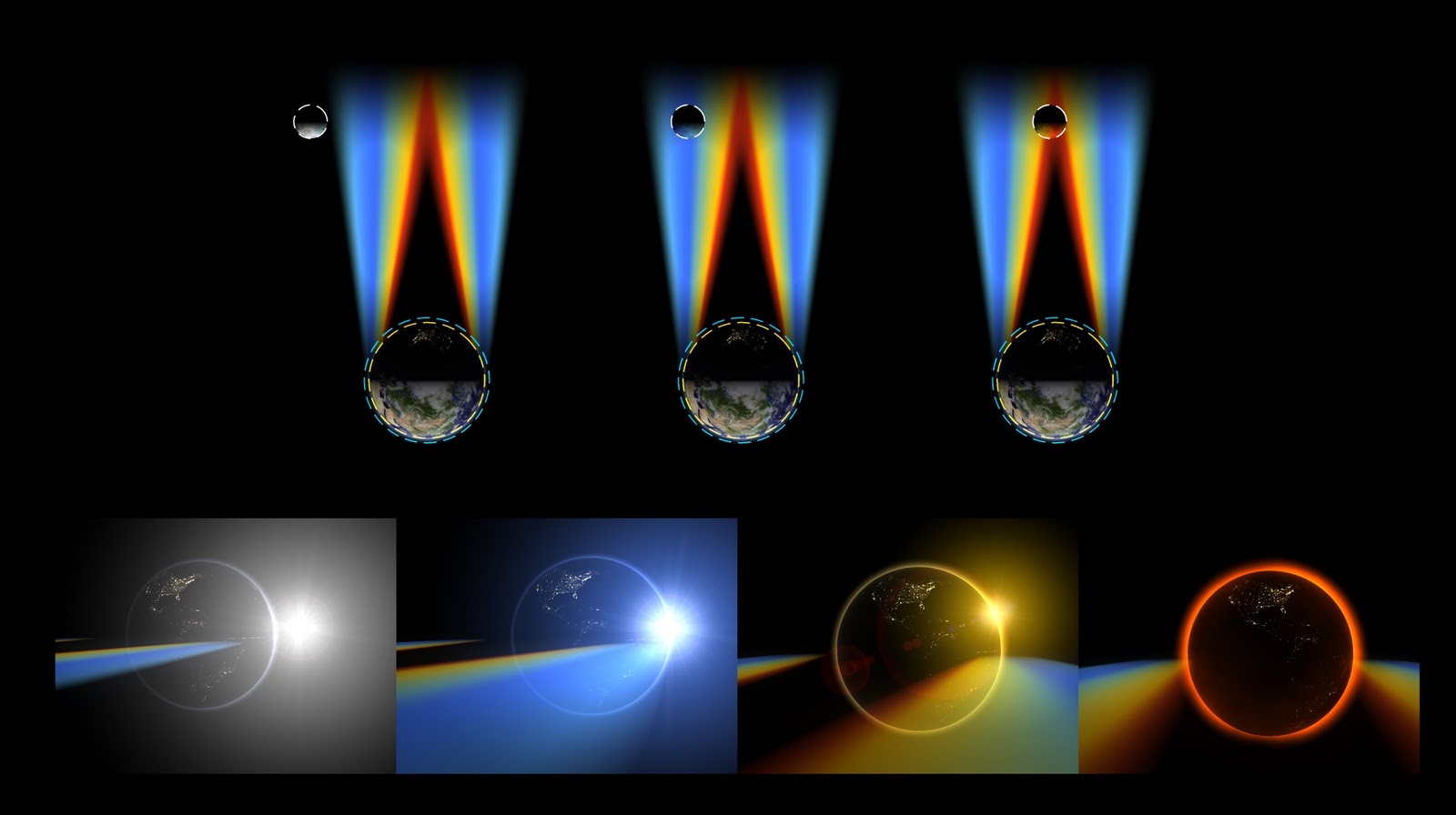
The two circles that you see show the two parts of the Earth's shadow. The outside circle (black) is called the penumbra and the inside circle (gray) is called the umbra. The penumbra is a region where only part of the Sun's light is blocked from the Sun and the Moon will have only subtle darkening. The umbral region is where all of the direct light from the Sun is blocked, but the Moon has a red/orange shine to it. This red illumination is caused by the Earth's atmosphere acting like a prism and separating the colors of light and bending the longer wavelengths (like red) toward the center of the shadow. It is this bent light that causes the Moon appear red. The illustration below shows how the Earth acts like a prism:
The top half of the image is looking down on both the Earth and the Moon and shows how the Earth's atmosphere separates the colors of light. The bottom half of the image shows what the Earth may look like from the Moon during an eclipse. (This beautiful image was also taken from Wikipedia.)
If you would like to observe the eclipse but it is too cold outside or there is cloud cover, you can watch it live on NASA streaming video here:
For those of us in the Central time zone (that would be me), the eclipse starts 11:27 pm tonight, totality begins at 1:40 am, the greatest eclipse (peak of totality) is at 2:17 am. If you get up very early in the morning, you can see the last bit of the eclipse before 5:06 am.
Clear skies!
Below is a very nice animation from Wikipedia on what tonight's eclipse will look like (UT is Universal Time - subtract 5 hours for Eastern time, 6 for Central, 7 for Mountain and 8 for Pacific):
The two circles that you see show the two parts of the Earth's shadow. The outside circle (black) is called the penumbra and the inside circle (gray) is called the umbra. The penumbra is a region where only part of the Sun's light is blocked from the Sun and the Moon will have only subtle darkening. The umbral region is where all of the direct light from the Sun is blocked, but the Moon has a red/orange shine to it. This red illumination is caused by the Earth's atmosphere acting like a prism and separating the colors of light and bending the longer wavelengths (like red) toward the center of the shadow. It is this bent light that causes the Moon appear red. The illustration below shows how the Earth acts like a prism:
The top half of the image is looking down on both the Earth and the Moon and shows how the Earth's atmosphere separates the colors of light. The bottom half of the image shows what the Earth may look like from the Moon during an eclipse. (This beautiful image was also taken from Wikipedia.)
If you would like to observe the eclipse but it is too cold outside or there is cloud cover, you can watch it live on NASA streaming video here:
For those of us in the Central time zone (that would be me), the eclipse starts 11:27 pm tonight, totality begins at 1:40 am, the greatest eclipse (peak of totality) is at 2:17 am. If you get up very early in the morning, you can see the last bit of the eclipse before 5:06 am.
Clear skies!
Wednesday, December 15, 2010
Becoming a Physicist II - The Cost $
One aspect that I didn't discuss in my last post about becoming a physicist is how to finance your education. Here are some thoughts and advice based on my experience...
COLLEGE
Going to college can be expensive. I know that first hand and this was a huge factor on where I chose to get by bachelor degree. I didn't have the best grades (yup, that's right - you don't have to be a genius to be a scientist) but they were nothing to sneeze at either. I ended up getting a large scholarship to a small school in western Maryland that almost no one has ever heard of (Frostburg State University, Frostburg, MD) and smaller offers from more notable schools. I chose Frostburg because I knew when I was in high school that I would need a graduate education to be the kind of physicist I wanted to be. And, honestly, not many people care where you got your bachelor degree from once you have your doctorate. A big name school can help you get into a good grad school, but it doesn't carry as much weight as you may think. At Frostburg, I was truly able to spread my wings and distinguish myself more than I feel I could have at a bigger school. (However, I don't know that for sure since I never really gave the big schools a chance.) It was these distinctions that made me attractive to graduate schools (for example, I graduated in less than 4 years with a good GPA).
In the end, I got a good education and into a great graduate program with a minimum of cost. Overall, I think I made the right choice for me. Remember, your situation will be different from mine - you need to do what is right for you.
GRAD SCHOOL
One of the questions I get asked most often when I talk to undergraduates about going to grad school is, "Great... And how much will that cost me?" They are almost always surprised when I tell them that you usually get paid to get a graduate degree in physics (or biology, chemistry, astronomy, engineering, etc.). The only science centered graduate training that I know costs a lot of money is medical school (and since this is what most people are familiar with, they apply the cost for med school to any graduate science training).
When you are accepted into a graduate program (usually Ph.D. - many physics programs, at least, do not require you earn a master degree on your way to your doctorate), you are usually accepted with a tuition wavier (meaning you don't pay any tuition) and a stipend you earn through an assistantship (usually a teaching assistantship in your early years and a research assistantship when you are performing your thesis research). I paid nothing for my Ph.D. They paid me to work as a physicist (remember in my last post I mentioned that grad school is more like an apprenticeship than course work? - this is an example of what I meant by that).
CONCLUSION
When working to become a Ph.D. physicist (or pretty much any scientist other than a medical doctor), the major cost involves getting you bachelor degree. After you are accepted into grad school, costs like tuition usually disappear and you start getting paid to do what you love (I hope you love it at this point!).
This picture (about Fall 2005) is of me and some of my best friends while we were in grad school. We all gathered at one of our apartments and made pizza from scratch - crust and all. It was a great time! I also like this picture because everyone in this picture ended up getting married! (The now wife of my friend third in from the left was taking this picture.) My husband and I are the last two on the right.
COLLEGE
Going to college can be expensive. I know that first hand and this was a huge factor on where I chose to get by bachelor degree. I didn't have the best grades (yup, that's right - you don't have to be a genius to be a scientist) but they were nothing to sneeze at either. I ended up getting a large scholarship to a small school in western Maryland that almost no one has ever heard of (Frostburg State University, Frostburg, MD) and smaller offers from more notable schools. I chose Frostburg because I knew when I was in high school that I would need a graduate education to be the kind of physicist I wanted to be. And, honestly, not many people care where you got your bachelor degree from once you have your doctorate. A big name school can help you get into a good grad school, but it doesn't carry as much weight as you may think. At Frostburg, I was truly able to spread my wings and distinguish myself more than I feel I could have at a bigger school. (However, I don't know that for sure since I never really gave the big schools a chance.) It was these distinctions that made me attractive to graduate schools (for example, I graduated in less than 4 years with a good GPA).
In the end, I got a good education and into a great graduate program with a minimum of cost. Overall, I think I made the right choice for me. Remember, your situation will be different from mine - you need to do what is right for you.
GRAD SCHOOL
One of the questions I get asked most often when I talk to undergraduates about going to grad school is, "Great... And how much will that cost me?" They are almost always surprised when I tell them that you usually get paid to get a graduate degree in physics (or biology, chemistry, astronomy, engineering, etc.). The only science centered graduate training that I know costs a lot of money is medical school (and since this is what most people are familiar with, they apply the cost for med school to any graduate science training).
When you are accepted into a graduate program (usually Ph.D. - many physics programs, at least, do not require you earn a master degree on your way to your doctorate), you are usually accepted with a tuition wavier (meaning you don't pay any tuition) and a stipend you earn through an assistantship (usually a teaching assistantship in your early years and a research assistantship when you are performing your thesis research). I paid nothing for my Ph.D. They paid me to work as a physicist (remember in my last post I mentioned that grad school is more like an apprenticeship than course work? - this is an example of what I meant by that).
CONCLUSION
When working to become a Ph.D. physicist (or pretty much any scientist other than a medical doctor), the major cost involves getting you bachelor degree. After you are accepted into grad school, costs like tuition usually disappear and you start getting paid to do what you love (I hope you love it at this point!).
This picture (about Fall 2005) is of me and some of my best friends while we were in grad school. We all gathered at one of our apartments and made pizza from scratch - crust and all. It was a great time! I also like this picture because everyone in this picture ended up getting married! (The now wife of my friend third in from the left was taking this picture.) My husband and I are the last two on the right.
Labels:
academic culture,
college,
grad school,
me
Friday, December 10, 2010
Becoming a Physicist
Lately, I've been looking back on the experiences that brought me to the point I am at now - working with LIGO as a scientist. It made me realize that many things happened throughout my education which brought me here today. So, for any readers out there who are thinking of becoming a scientist (not just one for LIGO) here is my advice.
HIGH SCHOOL
The bottom line about the high school experience is to learn as much as you can. It was a little bit disappointing when I got to college that no one cared about what great things I did when I was in high school. Colleges and universities stop caring about things like that once you have gained admission.
Therefore, the most important thing you can do is learn as much about what you want to do as you can. I was lucky to already know what I wanted to do when I was that young, but if you don't that's fine too! Just learn about what interests you the most at that time. It may turn out not to be something you want to do for the rest of your life but you will still have the knowledge you gained which will help you do whatever you end up doing. And you never know - your interests in high school may end up being your calling.
Since I knew that I wanted to be a physicist, I took all of the science that my high school offered me. In the end, I had 1 year of biology, 1 year of chemistry, 2 years of physics, a half year of astronomy, a half year of geology and a half year of ecology. If your high school doesn't offer this range of topics, that's fine! Just learn as much as you can in general.
COLLEGE
In college is where you start to make choices. What do I want to major in? What do I want to do with my degree? Do I want to continue on to grad school for a masters or Ph.D. or do I want to stop with a bachelors degree?
Don't panic! Most colleges do not make you declare a major until the end of your sophomore year BUT some majors require four years worth of coursework. Look at the requirements for the majors you are seriously considering and start taking some of the introductory classes. This will help you figure out if this is something you want to do for a living while making sure that you have some of the course work done if you decide it is (and if it isn't, introductory classes usually count towards your general education requirements).
Once you have decided to be a scientist, you need to think about what kind of scientist you want to be. I'm not talking about subject matter (biologist, chemist, physicist, etc.) but how much education you will need to do the work you are most interested in. This is a good time to seek out your advisor and start telling them about what you want from your education overall, and ask what degree you will need to do that work.
If grad school appears to be in your future, you need to make sure that you get the best grades you can in the classes that are part of your major (and overall too, but a bad grade in economics is easily overlooked when you have good grades in your major field) and gain some form of research experience.
A student who has research experience has an advantage over students who don't when applying to grad schools since research is the largest component to earning a graduate degree. There are many programs out there for you to get this experience over the summer. For example, the NSF gives grants to colleges to have undergraduates work with professors over the summer on their research. This program is called Research Experience for Undergraduates (REU - click here for more info). There are also similar programs out there. Caltech has the SURF program (Summer Undergraduate Research Fellowships) that do a lot of work with LIGO (including at the observatories in Livingston, LA and Hanford, WA) and the University of Florida has an International REU program where you can work on LIGO related research in a different country. (Find out more about these programs on ligo.org here.)
If you are going on to grad school, you will also need to think about what you want to specialize in. Let's say you are finishing your physics bachelors degree. All of your work so far has been very broad and covered the foundations of physics. In grad school, you will specialize in a particular part of physics. I specialized in gravity. Therefore, I am an expert on that subject matter, but if you ask me something about particle physics (like the Large Hadron Collider) I will only be able to tell you very general things about that since I am not an expert. It is a lot like asking your neurologist (brain & spinal cord specialist) about your upset stomach - he knows generalities but you would need to see a different specialist for a deeper answer. Having a good idea of what you want to specialize in will be helpful when applying to grad school so that they admit the right number of people for each specialty. That's not to say that you can't change your mind later, though.
GRAD SCHOOL
Now you have your bachelors degree in hand and you have been accepted to a grad school to work some subfield of your major. Your first year will be filled with very challenging classes that will make you think again about if this is something you REALLY want to do. Don't lose heart! The first year is always the hardest and when you make it through that, it gets much better.
Make sure that you find an advisor to start performing research with. After your first 2 years or so of grad school, the rest of the time you are there will be doing research for your thesis. Many people think that grad school is like signing up for more school like you had from 1st grade through college - classes. Grad school has some of that, but most of it is learning by doing research. Grad school is more like an apprenticeship than "school" as we normally think about it.
Fast-forward a few years. You are finishing your thesis and you are getting ready to finish your masters or Ph.D. What now? Well that depends on what you plan on doing next. Many people with masters degrees go on to work in industry. Most Ph.D.s are planning on going to a position in academia (college/university faculty positions). The interesting thing to consider is that most of these people will end up in industry and that's not a bad thing. For those getting Ph.D.s, they have been guided to this point by other Ph.D.'s who have usually never worked outside of academia. Therefore, they are being guided by people who don't necessarily have the experience to talk about doing anything else with their degree. Surveys have shown that those who move on to industry are just as happy, if not more so, than their classmates who went on to become college faculty.
If you are getting a Ph.D., chances are that you will be doing a postdoctoral (postdoc) appointment next. This is what I am doing right now and it allows to you better establish yourself in your field by doing more independent research and publishing your results.
Regardless, you are a bona fide <whatever it is you majored in>. One of the best but scariest things about my life right now is what lays ahead... Can I find a permanent position where I am (I would love that) or will I have to look elsewhere? Where am I going to end up? I really don't know the answers to these questions (yet) but I do know that I love doing LIGO research and will continue doing that wherever I end up!
Questions?
If you have any questions about becoming a scientist, feel free to contact me. Just leave a comment below or email me at amber@livingligo.org and I will be happy to talk with you!
HIGH SCHOOL
The bottom line about the high school experience is to learn as much as you can. It was a little bit disappointing when I got to college that no one cared about what great things I did when I was in high school. Colleges and universities stop caring about things like that once you have gained admission.
Therefore, the most important thing you can do is learn as much about what you want to do as you can. I was lucky to already know what I wanted to do when I was that young, but if you don't that's fine too! Just learn about what interests you the most at that time. It may turn out not to be something you want to do for the rest of your life but you will still have the knowledge you gained which will help you do whatever you end up doing. And you never know - your interests in high school may end up being your calling.
Since I knew that I wanted to be a physicist, I took all of the science that my high school offered me. In the end, I had 1 year of biology, 1 year of chemistry, 2 years of physics, a half year of astronomy, a half year of geology and a half year of ecology. If your high school doesn't offer this range of topics, that's fine! Just learn as much as you can in general.
COLLEGE
In college is where you start to make choices. What do I want to major in? What do I want to do with my degree? Do I want to continue on to grad school for a masters or Ph.D. or do I want to stop with a bachelors degree?
Don't panic! Most colleges do not make you declare a major until the end of your sophomore year BUT some majors require four years worth of coursework. Look at the requirements for the majors you are seriously considering and start taking some of the introductory classes. This will help you figure out if this is something you want to do for a living while making sure that you have some of the course work done if you decide it is (and if it isn't, introductory classes usually count towards your general education requirements).
Once you have decided to be a scientist, you need to think about what kind of scientist you want to be. I'm not talking about subject matter (biologist, chemist, physicist, etc.) but how much education you will need to do the work you are most interested in. This is a good time to seek out your advisor and start telling them about what you want from your education overall, and ask what degree you will need to do that work.
If grad school appears to be in your future, you need to make sure that you get the best grades you can in the classes that are part of your major (and overall too, but a bad grade in economics is easily overlooked when you have good grades in your major field) and gain some form of research experience.
A student who has research experience has an advantage over students who don't when applying to grad schools since research is the largest component to earning a graduate degree. There are many programs out there for you to get this experience over the summer. For example, the NSF gives grants to colleges to have undergraduates work with professors over the summer on their research. This program is called Research Experience for Undergraduates (REU - click here for more info). There are also similar programs out there. Caltech has the SURF program (Summer Undergraduate Research Fellowships) that do a lot of work with LIGO (including at the observatories in Livingston, LA and Hanford, WA) and the University of Florida has an International REU program where you can work on LIGO related research in a different country. (Find out more about these programs on ligo.org here.)
If you are going on to grad school, you will also need to think about what you want to specialize in. Let's say you are finishing your physics bachelors degree. All of your work so far has been very broad and covered the foundations of physics. In grad school, you will specialize in a particular part of physics. I specialized in gravity. Therefore, I am an expert on that subject matter, but if you ask me something about particle physics (like the Large Hadron Collider) I will only be able to tell you very general things about that since I am not an expert. It is a lot like asking your neurologist (brain & spinal cord specialist) about your upset stomach - he knows generalities but you would need to see a different specialist for a deeper answer. Having a good idea of what you want to specialize in will be helpful when applying to grad school so that they admit the right number of people for each specialty. That's not to say that you can't change your mind later, though.
GRAD SCHOOL
Now you have your bachelors degree in hand and you have been accepted to a grad school to work some subfield of your major. Your first year will be filled with very challenging classes that will make you think again about if this is something you REALLY want to do. Don't lose heart! The first year is always the hardest and when you make it through that, it gets much better.
Make sure that you find an advisor to start performing research with. After your first 2 years or so of grad school, the rest of the time you are there will be doing research for your thesis. Many people think that grad school is like signing up for more school like you had from 1st grade through college - classes. Grad school has some of that, but most of it is learning by doing research. Grad school is more like an apprenticeship than "school" as we normally think about it.
Fast-forward a few years. You are finishing your thesis and you are getting ready to finish your masters or Ph.D. What now? Well that depends on what you plan on doing next. Many people with masters degrees go on to work in industry. Most Ph.D.s are planning on going to a position in academia (college/university faculty positions). The interesting thing to consider is that most of these people will end up in industry and that's not a bad thing. For those getting Ph.D.s, they have been guided to this point by other Ph.D.'s who have usually never worked outside of academia. Therefore, they are being guided by people who don't necessarily have the experience to talk about doing anything else with their degree. Surveys have shown that those who move on to industry are just as happy, if not more so, than their classmates who went on to become college faculty.
If you are getting a Ph.D., chances are that you will be doing a postdoctoral (postdoc) appointment next. This is what I am doing right now and it allows to you better establish yourself in your field by doing more independent research and publishing your results.
Regardless, you are a bona fide <whatever it is you majored in>. One of the best but scariest things about my life right now is what lays ahead... Can I find a permanent position where I am (I would love that) or will I have to look elsewhere? Where am I going to end up? I really don't know the answers to these questions (yet) but I do know that I love doing LIGO research and will continue doing that wherever I end up!
Questions?
If you have any questions about becoming a scientist, feel free to contact me. Just leave a comment below or email me at amber@livingligo.org and I will be happy to talk with you!
Labels:
college,
grad school,
high school
Wednesday, December 1, 2010
APS Executive Board, Council & Thanksgiving
I hope all my US readers has a nice Thanksgiving holiday! It's been a while since I posted, so let me tell you a little about what I've been doing...
APS Executive Board & Council Meeting
My last post was about how doing professional service was a part of an academic life. That is exactly what I went off to do between 18-19 November at the APS Executive Board and Council Meetings. The first day, I flew out to Long Beach, CA where the meetings were taking place and, in the evening, I went to the Executive Board Dinner. I always like these more informal gatherings since it allows me to learn more about the others and am serving with and I always learn some thing new, be it about physics or some other bit of wisdom.
During the day of the 19th was the Executive Board Meeting and the Budget Committee Meeting. This meeting is where a smaller group of people go into much more detail on topics that will be brought to the Council. Basically, this is where many issues are debated first so that the Council Meetings proceed much more efficiently. This was a full day of meetings for me as the Executive Board Meeting was followed by a meeting of the Budget Committee (on which I also serve). This meeting of the Budget Committee saw the approval of the budget for next year. While I'm not enthralled by accounting, I've learned so much about how a large society like the APS stays afloat.
The evening of the 19th was the usual Council Reception and Dinner. This is just like the Executive Board Reception and Dinner, but we were treated to a special viewing of the Division on Fluid Dynamics' Gallery of Fluids in Motion (the Division of Fluid Dynamics meeting took place starting the day after the Council Meeting). Then we were able to watch the incredible videos illustrating current fluid dynamics research (you can see them too here - you can also find the still images linked from that page). My favorite one was the "Wet-Dog Shake" (found here - find the movie under "Ancillary Files" to the right of the page).
On the 20th was the Council Meeting (where I represent the Forum on Graduate Student Affairs). These meetings are open to the membership and the usual agenda proceeds as follows:
I flew home on the 21st only to ship out again to visit my family for Thanksgiving on the 23rd...
Visit to My High School Alma Mater
Since I went home to visit my family, I contacted my old high school and asked if they would be interested in me coming in and talking to students. They were nice enough to have me (and my husband) and we got to talk to the AP Physics class about what we do at LIGO; I talked about physics and my husband talked about engineering). The most rewarding thing for me was that I was in that class with the same teacher (Hi, Mr. Bowman!) when I went there. And it was there that I first fell in love with Relativity and gravity. So it was great to come back full circle. I also got to give a few copies of the poster I worked on with the APS to them (FYI, I'm not beyond shameless self-promotion.)
Thanksgiving
Thanksgiving went about as well as any family gathering goes. It was great to see everyone, but it wasn't without its own stress.
Thanksgiving day was full of baking and cooking and eating :) It was nice to get to see my family - especially my younger siblings!
I also got to have Thanksgiving, Round 2 with my husband's family on Saturday. That's one of the nice things about marrying your high school sweetheart - their family usually lives close to yours and you don't have to chose who to visit on the big holidays. Needless to say, I am very sick of turkey.
That's about all I have to talk about right now. Maybe later I will bore you with a post about catching up on work after a trip out of town :)
APS Executive Board & Council Meeting
My last post was about how doing professional service was a part of an academic life. That is exactly what I went off to do between 18-19 November at the APS Executive Board and Council Meetings. The first day, I flew out to Long Beach, CA where the meetings were taking place and, in the evening, I went to the Executive Board Dinner. I always like these more informal gatherings since it allows me to learn more about the others and am serving with and I always learn some thing new, be it about physics or some other bit of wisdom.
This is the view from my hotel room at the Long Beach Hyatt. This is one of the best views I've ever had.
During the day of the 19th was the Executive Board Meeting and the Budget Committee Meeting. This meeting is where a smaller group of people go into much more detail on topics that will be brought to the Council. Basically, this is where many issues are debated first so that the Council Meetings proceed much more efficiently. This was a full day of meetings for me as the Executive Board Meeting was followed by a meeting of the Budget Committee (on which I also serve). This meeting of the Budget Committee saw the approval of the budget for next year. While I'm not enthralled by accounting, I've learned so much about how a large society like the APS stays afloat.
The evening of the 19th was the usual Council Reception and Dinner. This is just like the Executive Board Reception and Dinner, but we were treated to a special viewing of the Division on Fluid Dynamics' Gallery of Fluids in Motion (the Division of Fluid Dynamics meeting took place starting the day after the Council Meeting). Then we were able to watch the incredible videos illustrating current fluid dynamics research (you can see them too here - you can also find the still images linked from that page). My favorite one was the "Wet-Dog Shake" (found here - find the movie under "Ancillary Files" to the right of the page).
On the 20th was the Council Meeting (where I represent the Forum on Graduate Student Affairs). These meetings are open to the membership and the usual agenda proceeds as follows:
- Approval of Minutes (8:30 AM)
- Report from the President
- Report from the Executive Officer
- Report from the Treasurer/Publisher
- Report from the Editor in Chief
- BREAK (10:10 AM)
- Fellowships
- Panel on Public Affairs
- LUNCH (Noon)
- Report from the Canadian Physical Society
- Report on Education and Diversity
- Report on Outreach
- BREAK (2:10 PM)
- Report on International Affairs
- Report from Washington
- Unit Bylaw Changes
- New Business
- CONCLUDE (3:30 PM)
My place at the APS Council Meeting. Even though this meeting is open to the membership, I didn't want to take a picture of the other Councilors since I didn't have their permission to post their photo on this site.
I flew home on the 21st only to ship out again to visit my family for Thanksgiving on the 23rd...
Visit to My High School Alma Mater
Since I went home to visit my family, I contacted my old high school and asked if they would be interested in me coming in and talking to students. They were nice enough to have me (and my husband) and we got to talk to the AP Physics class about what we do at LIGO; I talked about physics and my husband talked about engineering). The most rewarding thing for me was that I was in that class with the same teacher (Hi, Mr. Bowman!) when I went there. And it was there that I first fell in love with Relativity and gravity. So it was great to come back full circle. I also got to give a few copies of the poster I worked on with the APS to them (FYI, I'm not beyond shameless self-promotion.)
Thanksgiving
Thanksgiving went about as well as any family gathering goes. It was great to see everyone, but it wasn't without its own stress.
Thanksgiving day was full of baking and cooking and eating :) It was nice to get to see my family - especially my younger siblings!
I also got to have Thanksgiving, Round 2 with my husband's family on Saturday. That's one of the nice things about marrying your high school sweetheart - their family usually lives close to yours and you don't have to chose who to visit on the big holidays. Needless to say, I am very sick of turkey.
That's about all I have to talk about right now. Maybe later I will bore you with a post about catching up on work after a trip out of town :)
Labels:
APS,
high school,
me,
outreach,
personal life,
service
Wednesday, November 17, 2010
Professional Service
Sorry about the slow posting this week! I've been busy getting ready for a trip and Thanksgiving. By themselves, they aren't that bad but I still need to get my regular work done so I've been trying to get ahead on that. Hence, I haven't been on the blog as much as I'd like.
In my "About Me" section, I mention the 3 main parts of being an academic: research, teaching and service. I've already talked about my research and teaching, so let me tell you a little about professional service.
Service covers basically any activity that enriches your profession but doesn't come in the form of teaching or performing research in whatever it is you do. This could be sitting on a committee that helps ensure that the working environment is comfortable or you can serve the larger community through professional societies. For physicists, the main professional society is the American Physical Society (APS) but I am also a member of the American Association of Physics Teachers (AAPT) and the American Astronomical Society (AAS).
This week, I am traveling to the APS Board and Council Meetings. I sit on the APS Council as the representative of the Forum on Graduate Student Affairs (FGSA). The Council is the legal decision making body of the APS and we vote on everything from general statements, to journal subscription rates. Councilors are elected to the Board after 2 years (of a 4 year term) on the Council. The Board does more behind the scenes discussions on matters before they are brought to the Council for a vote. The Board meets 5 times a year and the Council twice (luckily for me, 2 of the Board Meetings happen the day before the Council meetings). I will be sure to post later this week on what happens at these meetings.
Service is often seen as thankless work. In many ways, it is. That is one of the reasons I try to find ways to serve that I personally feel are fulfilling; that way even if no one notices the work I do, I still feel good about it. Serving on the APS Board and Council is not only fulfilling, but I also feel deeply honored since I was elected by my peers to these posts.
The picture above shows Gay Stewart (University of Arkansas), Stefan Zollner (now of the New Mexico State University), and me at the LaserFest gala event that was held at the Smithsonian National Museum of American History on February 12th this year. All of us are on the APS Council and were invited to represent the APS. For me, this was a night when being nerdy was cool! I got to mingle with several Nobel Prize winners. This photo really doesn't show the extent that the Smithsonian went to for this gala. You can read more about it and see great pictures here. This is definitely a time when service was not thankless!
In my "About Me" section, I mention the 3 main parts of being an academic: research, teaching and service. I've already talked about my research and teaching, so let me tell you a little about professional service.
Service covers basically any activity that enriches your profession but doesn't come in the form of teaching or performing research in whatever it is you do. This could be sitting on a committee that helps ensure that the working environment is comfortable or you can serve the larger community through professional societies. For physicists, the main professional society is the American Physical Society (APS) but I am also a member of the American Association of Physics Teachers (AAPT) and the American Astronomical Society (AAS).
This week, I am traveling to the APS Board and Council Meetings. I sit on the APS Council as the representative of the Forum on Graduate Student Affairs (FGSA). The Council is the legal decision making body of the APS and we vote on everything from general statements, to journal subscription rates. Councilors are elected to the Board after 2 years (of a 4 year term) on the Council. The Board does more behind the scenes discussions on matters before they are brought to the Council for a vote. The Board meets 5 times a year and the Council twice (luckily for me, 2 of the Board Meetings happen the day before the Council meetings). I will be sure to post later this week on what happens at these meetings.
Service is often seen as thankless work. In many ways, it is. That is one of the reasons I try to find ways to serve that I personally feel are fulfilling; that way even if no one notices the work I do, I still feel good about it. Serving on the APS Board and Council is not only fulfilling, but I also feel deeply honored since I was elected by my peers to these posts.
![]() |
| Photo by Ken Cole, APS |
The picture above shows Gay Stewart (University of Arkansas), Stefan Zollner (now of the New Mexico State University), and me at the LaserFest gala event that was held at the Smithsonian National Museum of American History on February 12th this year. All of us are on the APS Council and were invited to represent the APS. For me, this was a night when being nerdy was cool! I got to mingle with several Nobel Prize winners. This photo really doesn't show the extent that the Smithsonian went to for this gala. You can read more about it and see great pictures here. This is definitely a time when service was not thankless!
Subscribe to:
Posts (Atom)